

Modern enterprises face an evolving landscape of cyber threats that target endpoints as the weakest link in organizational defenses. As remote work, BYOD policies, and cloud adoption expand the attack surface, businesses require comprehensive endpoint protection that goes beyond traditional antivirus. McAfee Endpoint Security represents a complete platform designed to defend workstations, servers, and mobile devices against sophisticated malware, zero-day exploits, ransomware, and advanced persistent threats. This guide examines how organizations can leverage mcafee endpoint security to build resilient defenses that align with contemporary security frameworks and operational requirements.
McAfee Endpoint Security consolidates multiple protection technologies into a unified agent architecture that reduces resource consumption while enhancing security efficacy. The platform replaces legacy point solutions with an integrated approach that combines threat prevention, detection, and response capabilities.
The single-agent design delivers antivirus, firewall, web control, and threat intelligence through one lightweight client. This architectural approach minimizes endpoint performance impact while simplifying deployment and management across heterogeneous IT environments.
McAfee endpoint security organizes its capabilities into specialized modules that address distinct threat vectors:
Each module operates cooperatively, sharing threat intelligence and context to improve detection accuracy and reduce false positives. The modular architecture allows organizations to activate only required capabilities, optimizing resource allocation.

Successful mcafee endpoint security implementation requires careful planning around management infrastructure, agent deployment methodologies, and policy frameworks. Organizations must evaluate their existing environment to determine the optimal architecture.
| Console Type | Best For | Key Capabilities |
|---|---|---|
| McAfee ePO | Large enterprises | Centralized multi-site management, extensive reporting, custom automation |
| MVISION Cloud | Cloud-native deployments | SaaS delivery, rapid deployment, mobile workforce support |
| Hybrid | Mixed environments | On-premises control with cloud scalability |
The ePolicy Orchestrator (ePO) serves as the traditional management platform for mcafee endpoint security, providing centralized visibility across distributed endpoints. Organizations with established on-premises infrastructure typically leverage ePO for its deep integration capabilities and extensive policy controls.
Cloud-native alternatives through MVISION deliver simplified deployment for organizations embracing SaaS architectures. The cloud console reduces infrastructure overhead while maintaining comprehensive endpoint protection and compliance reporting.
Organizations should evaluate multiple deployment vectors based on their network topology and operational constraints:
The installation process for McAfee products requires careful attention to system prerequisites, network connectivity requirements, and policy inheritance models. Pre-deployment testing in isolated environments helps identify compatibility issues before production rollout.
McAfee endpoint security incorporates sophisticated detection mechanisms that extend beyond signature-based antivirus to identify emerging threats and suspicious behaviors.
The platform employs multiple machine learning models trained on billions of samples to classify unknown files and executables. These models analyze file characteristics, code structures, and runtime behaviors to assign reputation scores and threat classifications.
Behavioral analysis monitors process activity, registry modifications, network connections, and file system changes to identify anomalous patterns indicative of malicious intent. This approach proves particularly effective against fileless attacks, living-off-the-land techniques, and memory-resident malware.
Modern attacks frequently leverage vulnerabilities in legitimate applications to gain initial access. McAfee endpoint security implements multi-layered exploit mitigation:
These techniques provide critical protection during the vulnerability window between public disclosure and patch deployment, reducing organizational exposure to known CVEs tracked in repositories like the NIST National Vulnerability Database.

Contemporary security architectures embrace Zero Trust principles that eliminate implicit trust and require continuous verification. McAfee endpoint security aligns with frameworks outlined in NIST Special Publication 800-207 through several key capabilities.
Zero Trust architectures demand real-time visibility into endpoint security posture before granting access to resources. Mcafee endpoint security provides continuous assessment through:
This telemetry integrates with network access control (NAC) solutions, identity providers, and cloud access security brokers (CASB) to enforce conditional access policies based on endpoint risk scores.
The platform supports dynamic policy adjustment based on user context, location, network environment, and detected threats. Organizations can implement graduated access controls that restrict privileges when endpoints exhibit suspicious behavior or fail compliance checks.
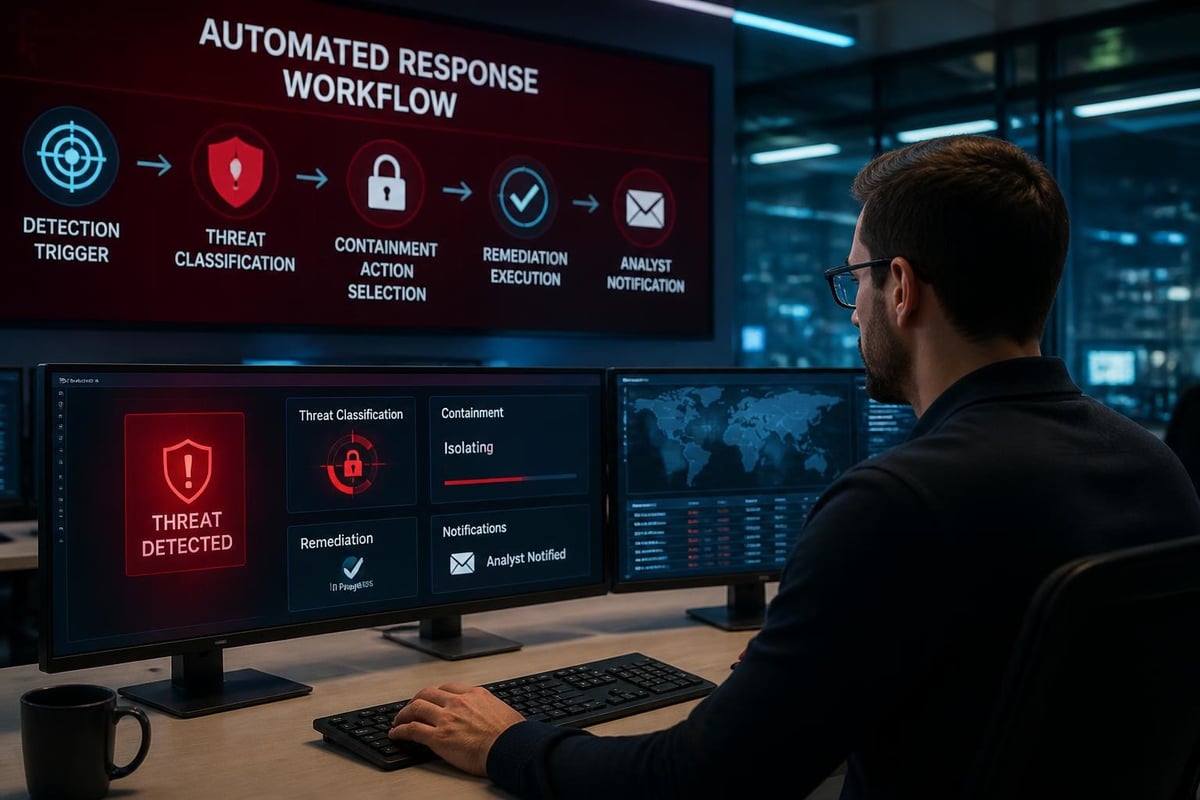
Policy automation through ePO enables responses like network quarantine, application blocking, or administrative notification when thresholds trigger. This reduces response time from hours to seconds for critical threats.
Endpoint security solutions must balance protection efficacy with system performance impact to maintain user productivity and hardware longevity. McAfee endpoint security incorporates several optimization techniques.
Intelligent scanning algorithms prioritize high-risk file types and locations while skipping trusted files validated through reputation databases. Organizations should configure appropriate exclusions for:
Careful exclusion management balances performance optimization with maintained security coverage. Documentation and regular review prevent security gaps from outdated configurations.
The platform allows administrators to configure CPU and I/O limits during active scanning operations. Scheduled scanning can align with maintenance windows or low-usage periods to minimize user impact.
| Resource Control | Configuration Options | Recommended Setting |
|---|---|---|
| CPU throttling | 0-100% maximum | 50% for user workstations |
| Scan scheduling | Fixed time, on-demand, continuous | Daily during lunch break |
| Update frequency | Real-time, hourly, daily | Hourly for workstations |
Modern SSD-based endpoints demonstrate significantly less performance degradation than traditional spinning disk systems. Organizations should establish baseline metrics before deployment and monitor post-implementation impact through user feedback and system telemetrics.
Effective endpoint protection requires current threat intelligence to identify emerging attack patterns and malicious infrastructure. McAfee endpoint security connects to the Global Threat Intelligence (GTI) network that aggregates data from millions of sensors worldwide.
When mcafee endpoint security encounters unknown files, URLs, or network connections, it queries cloud-based reputation services that deliver verdicts within milliseconds. This approach provides protection against brand-new threats without requiring local signature updates.
The reputation system evaluates multiple factors including file prevalence, source reputation, certificate validity, and behavioral indicators observed from other endpoints. High-confidence verdicts enable automatic blocking while borderline cases trigger additional analysis.
Organizations can configure automated containment actions when threats are detected:
Response automation reduces the window of opportunity for attackers while freeing security teams to focus on complex investigations rather than repetitive triage tasks.
McAfee endpoint security supports compliance requirements across multiple regulatory frameworks including PCI DSS, HIPAA, GDPR, and industry-specific mandates. The platform provides evidence collection and reporting capabilities that simplify audit processes.
Comprehensive logging captures security events, policy changes, threat detections, and remediation actions with tamper-evident storage. Pre-built compliance reports map endpoint security controls to specific regulatory requirements.
Organizations can demonstrate:
The reporting infrastructure supports scheduled delivery to stakeholders and integration with SIEM platforms for centralized security operations.
Built-in policy templates align with CIS Benchmarks and vendor hardening guides for Windows, macOS, and Linux endpoints. These templates provide secure baseline configurations that organizations can customize based on operational requirements and risk tolerance.
Regular policy reviews ensure configurations remain aligned with evolving threats and regulatory expectations. Version control capabilities track policy changes and enable rollback if updates cause operational issues.
While traditional endpoint protection focuses on prevention, modern threats require detection and response capabilities to identify and contain sophisticated attacks that bypass initial defenses. McAfee endpoint security includes EDR functionality that extends protection depth.
Continuous telemetry collection captures process execution chains, file modifications, registry changes, and network activity. Security analysts can query historical data to investigate suspicious patterns or hunt for indicators of compromise.
The platform retains configurable periods of endpoint activity data, enabling retrospective analysis when new threat intelligence emerges. Organizations can search across all endpoints simultaneously to identify lateral movement, persistence mechanisms, or data exfiltration attempts.
The SANS white paper on EDR effectiveness examines how these capabilities complement Zero Trust controls in enterprise environments.
When incidents occur, mcafee endpoint security provides investigators with detailed forensic capabilities:
These capabilities reduce the need for specialized forensic tools while maintaining evidence integrity for potential legal proceedings.
Organizations evaluating mcafee endpoint security should benchmark capabilities against alternative platforms using objective testing and real-world performance metrics.
Third-party evaluation labs provide unbiased assessments of protection efficacy, performance impact, and usability. AV-Comparatives publishes regular enterprise endpoint security tests that measure:
Historical test results demonstrate consistent improvement in detection rates and performance optimization across mcafee endpoint security releases. Organizations should review recent test cycles when evaluating current platform capabilities.
| Cost Factor | McAfee Endpoint Security | Alternative Considerations |
|---|---|---|
| Licensing model | Per-endpoint perpetual or subscription | Evaluate multi-year commitments |
| Infrastructure requirements | ePO servers or cloud subscription | Factor deployment and maintenance costs |
| Training and expertise | Established knowledge base | Consider staff learning curves |
| Integration complexity | Strong SIEM and SOAR support | Assess API capabilities and partnerships |
Beyond license costs, organizations must evaluate operational expenses including management infrastructure, staff training, and integration efforts. Platforms with established market presence often benefit from extensive documentation, partner ecosystems, and available expertise.
While mcafee endpoint security addresses cyber threats, organizations should recognize that comprehensive security requires coordination between digital and physical protection layers. Businesses face risks from both network-based attacks and physical intrusion attempts.
Just as endpoint security software protects digital assets through continuous monitoring and layered defenses, physical security solutions safeguard facilities and inventory. For organizations in South Africa and similar markets with elevated security concerns, integrating robust physical barriers complements endpoint protection strategies. When securing office locations that house critical IT infrastructure or sensitive data, consider Monkey-Proof Security Gates that prevent unauthorized physical access to server rooms and secure areas. The same defense-in-depth philosophy that drives mcafee endpoint security architecture applies equally to physical security implementations.

A holistic security approach recognizes that attackers often exploit the weakest access vector, whether digital or physical. Server rooms, data centers, and administrative offices require physical access controls that match the sophistication of cyber defenses.
The proliferation of smartphones and tablets as primary business devices extends the endpoint protection challenge beyond traditional workstations. McAfee endpoint security addresses mobile threats through platform-specific capabilities.
Mobile endpoints require different protection approaches due to operating system architectures and usage patterns:
Organizations must balance security requirements with user privacy expectations, particularly for personally-owned devices. Clear policies and transparent communication help maintain user acceptance while protecting corporate data.
The distributed workforce trend creates endpoint protection challenges related to network visibility, device diversity, and user behavior. McAfee endpoint security supports remote endpoints through:
Remote endpoints require particular attention to update mechanisms, support processes, and user training to maintain security posture outside traditional network perimeters.
Organizations moving from legacy antivirus solutions or earlier McAfee products to current mcafee endpoint security versions require structured migration approaches to minimize disruption and maintain continuous protection.
Short-term coexistence of old and new endpoint protection allows phased migration with rollback capabilities. Key considerations include:
Organizations should allocate sufficient testing time to validate application compatibility, performance characteristics, and management workflows before broad deployment.
Complete removal of previous endpoint protection solutions prevents resource consumption from dormant agents and eliminates potential conflicts. Automated uninstallation through management platforms ensures consistent cleanup across all endpoints.
Documentation of the previous configuration helps replicate equivalent protection policies in the new platform. Organizations should maintain legacy management infrastructure briefly post-migration to address any endpoints that miss initial deployment waves.
Successful mcafee endpoint security deployment requires ongoing performance monitoring and optimization to maintain user productivity while preserving security efficacy.
Organizations should measure endpoint performance metrics before deployment to establish comparison baselines:
Repeating measurements post-deployment quantifies actual impact and identifies outlier systems requiring tuning. User surveys complement objective metrics by capturing subjective productivity perceptions.
McAfee endpoint security includes built-in optimization recommendations based on observed usage patterns and detected bottlenecks. Regular review of these suggestions helps maintain optimal performance:
| Optimization Area | Common Issues | Resolution Approaches |
|---|---|---|
| Scan timing | Peak-hour performance impact | Reschedule to off-hours or distributed times |
| Exclusion gaps | Over-scanning trusted locations | Add database paths, development directories |
| Update frequency | Bandwidth saturation | Implement staged rollouts, local repositories |
| Policy complexity | Excessive rule evaluation | Consolidate redundant policies, simplify conditions |
Endpoint diversity requires customized optimization approaches. Database servers, developer workstations, and standard office PCs benefit from different tuning strategies aligned with their distinct usage patterns.
The endpoint protection landscape continues evolving in response to emerging threats, technological advances, and changing work patterns. McAfee endpoint security development roadmaps reflect several key trends.
Next-generation threat detection increasingly relies on artificial intelligence models that identify subtle attack indicators invisible to human analysts. Deep learning approaches analyze vast feature sets to classify unknown files with increasing accuracy.
Adversarial machine learning research helps security vendors develop models resistant to evasion techniques that attackers employ to bypass AI-based detection. This ongoing arms race drives continuous improvement in detection efficacy.
Endpoint telemetry provides critical visibility, but comprehensive threat detection requires correlation across network, email, cloud, and identity data sources. Extended Detection and Response (XDR) platforms aggregate signals from multiple security tools to identify complex attack patterns.
McAfee endpoint security integration with broader XDR ecosystems enables security operations centers to investigate incidents more efficiently and respond with coordinated actions across multiple control points.
The convergence of endpoint security with identity, network access control, and data protection reflects the Zero Trust architecture principle of continuous verification. Future endpoint protection will provide increasingly granular policy enforcement based on user, device, application, and data sensitivity contexts.
Microsegmentation at the endpoint level will restrict lateral movement even for authenticated users, limiting the blast radius when credentials are compromised or insiders act maliciously.
Protecting enterprise endpoints requires comprehensive platforms that balance prevention, detection, and response capabilities while maintaining system performance and user productivity. McAfee Endpoint Security delivers layered defenses suitable for organizations navigating modern threat landscapes and distributed workforce challenges. Just as businesses invest in robust digital protections, physical security remains equally critical for comprehensive risk management. Limax Security Specialists understands that true security requires both cyber and physical defenses working in concert, offering premium security solutions that protect South African homes and businesses with the same dedication to quality and reliability that drives enterprise endpoint protection strategies.


