
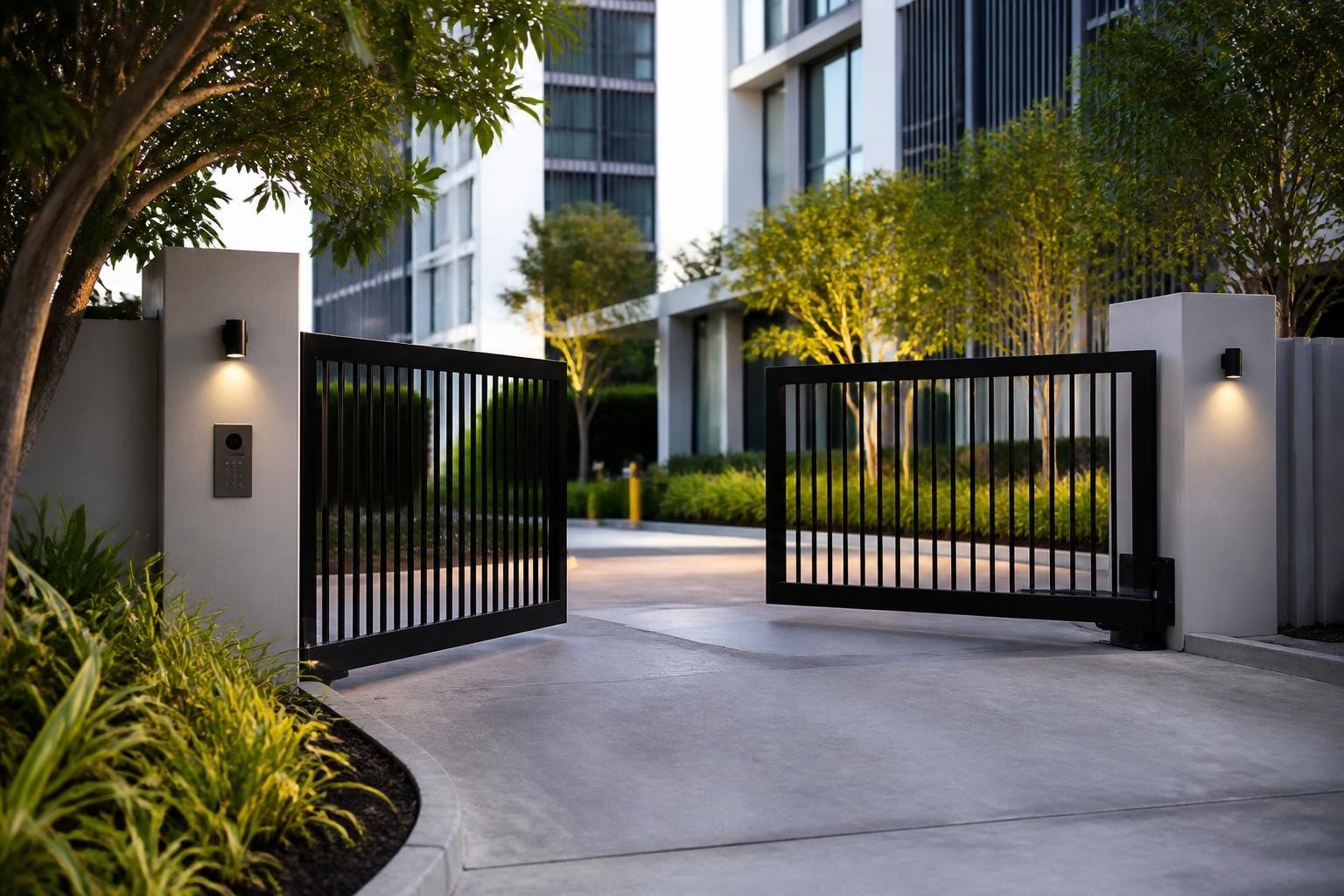
A security swing gate represents one of the most effective perimeter control solutions for residential estates, commercial facilities, and industrial sites across South Africa. These automated or manual barrier systems combine physical security with controlled access, creating a first line of defense that deters unauthorized entry while maintaining convenient passage for authorized personnel and vehicles. As property security needs evolve in 2026, understanding the technical specifications, regulatory compliance, and operational requirements of swing gate systems has become essential for property managers, security professionals, and homeowners alike.
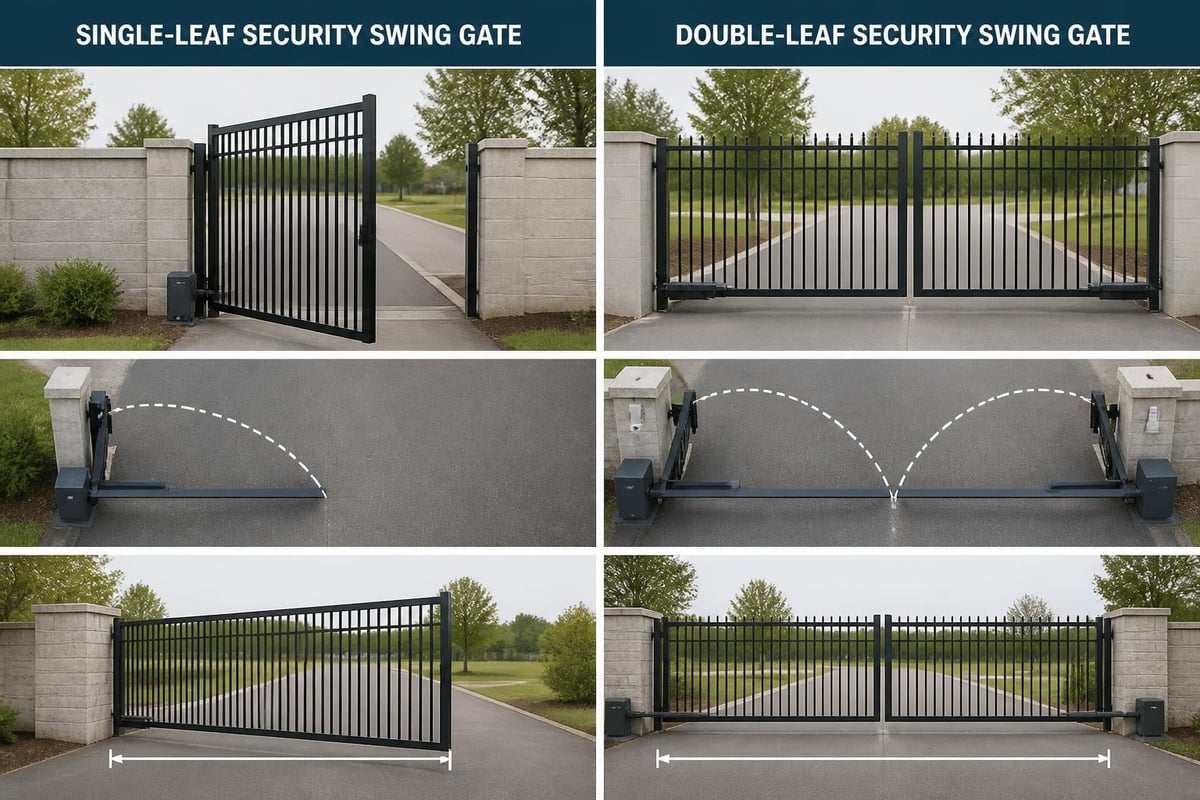
The fundamental design of a security swing gate involves one or two panels that pivot on hinges or posts to allow or restrict vehicular and pedestrian access. Single-leaf configurations use one panel that swings inward or outward, typically installed where space constraints exist on one side of the opening. Double-leaf systems employ two panels that meet in the center, distributing the structural load and accommodating wider driveways or access roads.
Single-leaf gates work best for openings up to 5 meters wide, though they require sufficient clearance radius for the panel to swing fully open. The entire weight concentrates on one hinge post, demanding robust foundation work and heavy-duty hardware.
Double-leaf configurations handle openings from 5 to 12 meters effectively, with each panel carrying half the total span. This distribution reduces stress on individual hinge points and allows faster opening cycles.
| Configuration | Max Opening Width | Foundation Requirement | Opening Time | Best Application |
|---|---|---|---|---|
| Single-leaf | 5 meters | Heavy-duty single post | 8-12 seconds | Residential driveways, narrow access |
| Double-leaf | 12 meters | Two moderate posts | 6-10 seconds | Commercial entrances, wide roads |
| Bi-parting double | 15+ meters | Two heavy posts + center ground track | 10-15 seconds | Industrial facilities, high-traffic |
The swing direction-inward versus outward-affects both security posture and compliance. Outward-swinging gates resist forced entry more effectively since attackers must pull against the latch mechanism rather than push. However, federal accessibility guidance recommends inward swings in certain pedestrian applications to avoid blocking public walkways or sidewalks.
Material choice directly impacts longevity, maintenance requirements, and security performance. Steel remains the dominant material for security swing gate construction in South Africa, offering superior strength-to-weight ratios and ram-resistance capabilities.
Mild steel (grade 250) provides adequate strength for residential applications, while commercial and high-security installations typically specify grade 350 or higher. The steel thickness ranges from 2mm for decorative infill panels to 6mm for main structural members and ram-rated installations.
Corrosion protection determines service life in coastal and industrial environments:
Aluminum security swing gate systems appeal to residential clients seeking low maintenance and modern aesthetics. Though aluminum offers inferior ram resistance compared to steel, extruded aluminum frames with infill panels can achieve adequate security for low-to-moderate risk applications.
The gate infill-the material between the frame members-balances visibility, aesthetics, and security:
Modern security swing gate installations increasingly incorporate automated operators, eliminating manual operation while integrating with access control systems. UL 325 standards for gate operators establish safety requirements that all automated systems must meet, including entrapment protection and emergency release mechanisms.
Electromechanical operators use electric motors with gear reduction to swing the gate panels. These systems handle gates up to 500kg per leaf and require 220V AC power or solar charging systems with battery backup.
Hydraulic operators provide superior force and reliability for heavy industrial gates exceeding 500kg per leaf. The hydraulic fluid maintains consistent performance across temperature extremes and offers built-in shock absorption during wind gusts.
Solar-powered systems have become increasingly viable in South Africa's high-insolation climate, with modern panels and battery arrays supporting continuous operation even during multi-day load-shedding events.
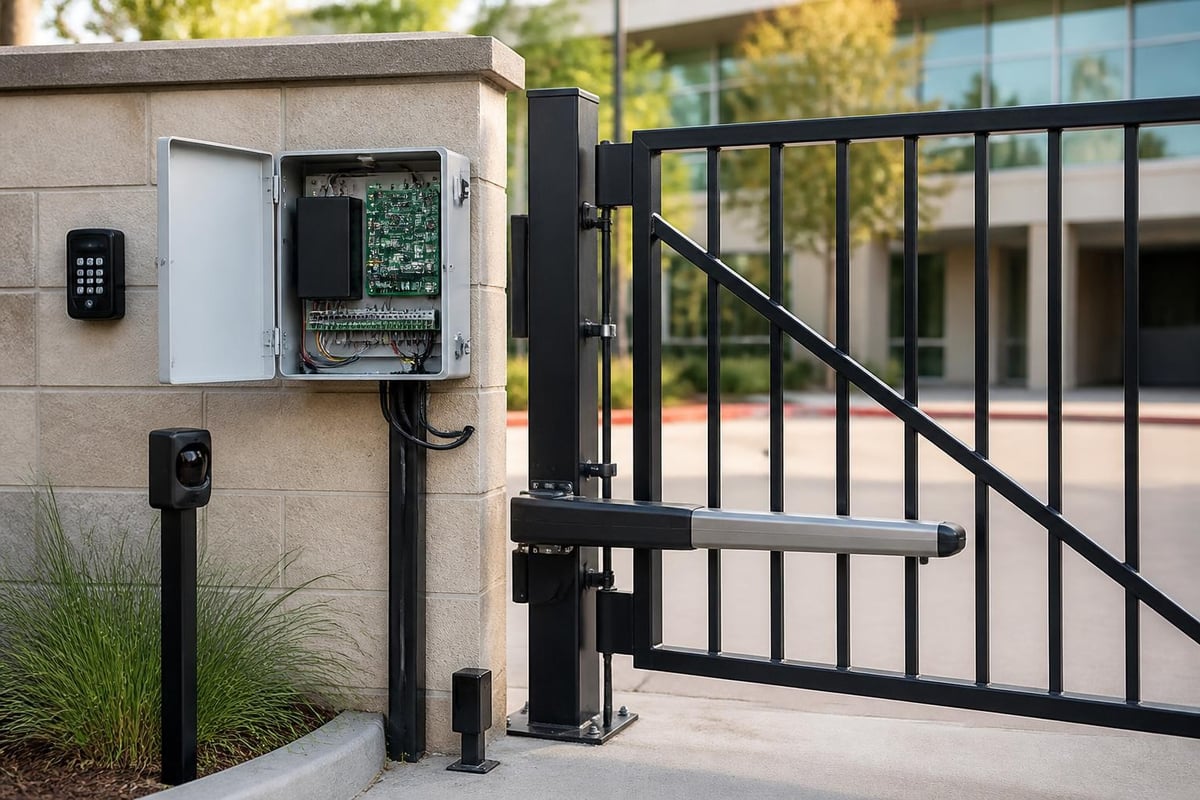
Safety sensors prevent the gate from closing on vehicles, pedestrians, or objects in the swing path. Compliant installations incorporate multiple sensor types:
The 2026 safety standards require automatic reversal within 2 seconds of obstruction detection and a maximum closing force of 15 pounds at the gate's leading edge.
A security swing gate functions as an enforcement point for access policies, requiring integration with authentication systems that verify user credentials before allowing passage. The access control architecture determines who can enter, when they can enter, and creates an audit trail of all access events.
RFID proximity cards and tags remain the most common commercial credential, with users presenting a card or tag to a reader mounted on a pedestal near the gate. Modern RFID systems operate at 13.56 MHz (Mifare, DESfire) for enhanced security and support encrypted communication between card and reader.
License plate recognition (LPR) systems use cameras and optical character recognition to read vehicle registration plates, automatically opening for pre-authorized vehicles. LPR eliminates credential distribution but requires well-maintained license plates and adequate lighting.
Mobile credentials delivered through smartphone apps represent the fastest-growing access method, using Bluetooth Low Energy or NFC to communicate with gate readers. These systems allow remote credential issuance and instant deactivation without physical card collection.
Biometric readers verify fingerprints, facial features, or iris patterns for high-security applications where credential sharing poses unacceptable risk. The biometric data remains stored in encrypted databases that link verified individuals to access permissions.
The gate control panel serves as the central processor, receiving inputs from access readers, safety sensors, and manual controls while commanding the operator motor. Modern panels feature:
For properties requiring multiple entry points, centralized access control platforms manage all gates, doors, and barriers from a single interface. These systems enable security personnel to monitor all access points, receive real-time alerts for forced entry attempts, and remotely lock down facilities during emergencies.
Proper site preparation ensures reliable operation and compliance with safety standards. The installation process begins with site assessment, evaluating existing conditions that affect gate placement, foundation requirements, and operational clearances.
The hinge posts carrying the gate's full weight require substantial concrete foundations. Engineering calculations determine the exact dimensions, but typical residential installations use:
The concrete must cure for minimum 7 days before gate installation, with 14-21 days preferred for heavy gates. Steel posts embed directly into wet concrete or bolt to steel plates cast into the foundation.
Federal guidance on vehicle incident prevention recommends establishing clear zones around security gates to prevent vehicle concealment and ensure operator sightlines. Minimum clearances include:
Where gates interface with public roadways or streets, coordination with local traffic authorities ensures compliance with signage, striping, and traffic control device standards that warn approaching motorists of the controlled access point.
A security swing gate functions most effectively as one component within a comprehensive perimeter security strategy rather than as a standalone barrier. Integrating the gate with fencing, surveillance, and intrusion detection creates defense-in-depth that addresses multiple threat scenarios.
The gate must match or exceed the security rating of the adjoining fence. Installing a high-security swing gate within standard residential fencing creates an obvious weak point where intruders simply bypass the gate by scaling adjacent fence sections.
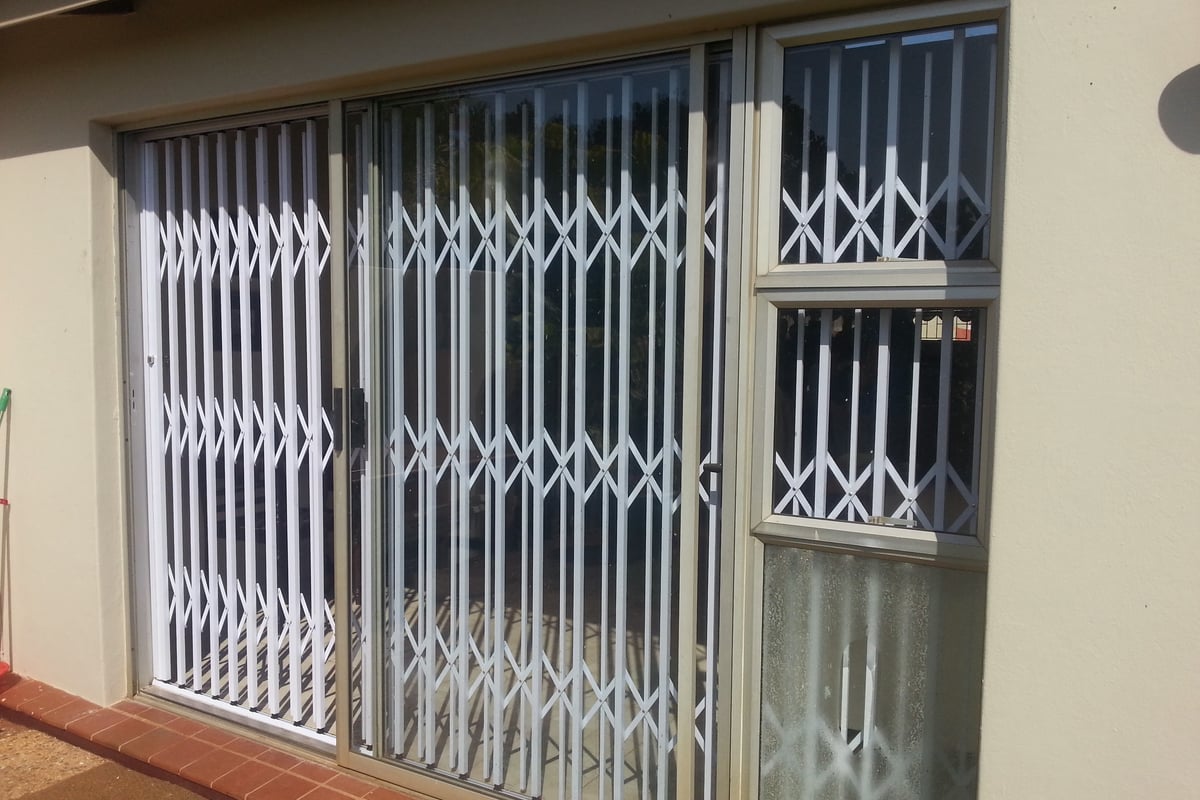
For residential properties with decorative gates and fencing, the gate still serves valuable functions even when physical security ratings differ. The controlled access point creates psychological deterrence, enables visitor screening, and establishes property boundaries. Many homeowners seeking enhanced protection complement their security swing gate with additional measures like specialized security barriers that address windows and other vulnerable entry points.
Video surveillance integration provides visual verification of access requests and forensic evidence of security incidents. Cameras positioned to capture vehicle license plates, driver faces, and pedestrian approaches create accountability and support investigations. Modern IP cameras with analytics detect loitering, wrong-way movement, or tampering with gate hardware.
Intrusion detection sensors mounted on the gate itself alert security personnel to forced entry attempts. Magnetic contacts detect gate opening outside authorized access events, while vibration sensors identify cutting, climbing, or ramming attacks.
Systematic maintenance prevents premature failure and ensures safety system integrity throughout the gate's operational life. Comprehensive maintenance protocols establish inspection schedules, testing procedures, and component replacement intervals that maximize reliability.
Property managers or security staff should perform basic monthly inspections:
Professional technicians should conduct quarterly maintenance:
Typical service life for major components under normal operating conditions:
| Component | Service Life | Replacement Trigger |
|---|---|---|
| Operator motor/gear assembly | 8-12 years | Excessive noise, slow operation, overcurrent |
| Hydraulic pump and cylinder | 10-15 years | Fluid leaks, inconsistent speed, pressure loss |
| Control board | 5-8 years | Intermittent operation, display failures |
| Battery backup | 3-5 years | Reduced capacity, voltage instability |
| Photoelectric sensors | 5-7 years | Alignment drift, weather damage |
| Access card readers | 6-10 years | Read failures, weather seal deterioration |
Certain installations present unique requirements that demand specialized security swing gate configurations or supplementary systems.
Properties facing vehicle-borne attack threats require gates engineered and tested to specific impact ratings. K-rated barriers (K4, K8, K12) indicate the ability to stop vehicles of specified weight traveling at defined speeds. A K12-rated gate stops a 15,000-pound vehicle traveling at 50 mph.
These installations incorporate:
Marine environments within 5km of the ocean require enhanced corrosion protection beyond standard hot-dip galvanizing. Specification upgrades include:
Areas experiencing high winds, heavy snow, or extreme temperatures need gates engineered for environmental loads:
Security swing gate installations must comply with multiple regulatory frameworks addressing safety, accessibility, and building codes. Non-compliant installations expose property owners to liability and may require costly retrofits.
Local building departments enforce national building codes that specify minimum standards for automated gates. Key requirements include:
Properties serving the public must ensure gate installations don't create barriers for individuals with disabilities. Accessible design features include:
Property owners bear responsibility for injuries or property damage resulting from gate malfunction or improper installation. Adequate insurance coverage and risk mitigation strategies include:
Security swing gate systems deliver controlled access, perimeter protection, and visual deterrence when properly specified, installed, and maintained according to current standards. Whether securing a residential estate, commercial facility, or industrial site, the right combination of structural design, automation technology, and access control integration creates effective barriers that balance security requirements with operational convenience. Limax Security Specialists brings decades of experience in designing and installing comprehensive security solutions across South Africa, from automated swing gates and perimeter barriers to window protection and complete property security systems tailored to your specific needs and risk profile.


