

Modern businesses face an escalating threat landscape where ransomware, zero-day exploits, and advanced persistent threats (APTs) target endpoints as the primary entry vector. Kaspersky endpoint security delivers multi-layered protection designed to defend workstations, servers, and mobile devices against sophisticated attacks while maintaining operational performance. Organizations evaluating endpoint protection platforms need to understand not just feature sets but real-world efficacy, deployment flexibility, and integration capabilities that align with their security posture.
Kaspersky endpoint security employs a defense-in-depth approach combining signature-based detection, behavioral analysis, and machine learning models. The architecture consists of several integrated protection layers that work simultaneously to identify and neutralize threats before they execute.
The foundation begins with traditional antivirus scanning that leverages Kaspersky's global threat intelligence network. This database receives updates multiple times per hour, ensuring endpoints maintain current protection against known malware families. Beyond signatures, the platform implements System Watcher technology that monitors process behavior in real time, identifying anomalous activities that indicate zero-day attacks or fileless malware.

Memory protection and exploit prevention modules specifically target techniques attackers use to bypass traditional defenses. These components monitor application memory for injection attempts, return-oriented programming (ROP) chains, and other exploit primitives. When suspicious activity is detected, the system can terminate processes, roll back changes, or quarantine affected files without user intervention.
The Kaspersky Security Network (KSN) provides cloud-assisted threat intelligence that enhances local detection capabilities. When an endpoint encounters an unknown file or behavior, it can query KSN for reputation data and analysis results from Kaspersky's global sensor network.
Key cloud-assisted capabilities include:
Organizations can configure KSN participation levels to balance security benefits against privacy requirements. Endpoints in highly regulated environments can operate in offline mode while still receiving scheduled definition updates.
Kaspersky endpoint security supports multiple deployment models tailored to organizational size and infrastructure preferences. The platform scales from small businesses with dozens of endpoints to enterprises managing tens of thousands of devices across global locations.
| Deployment Model | Best For | Key Features |
|---|---|---|
| On-premises | Organizations with existing data center infrastructure | Full control, air-gapped networks, custom retention |
| Cloud-managed | Distributed workforces, rapid deployment | No infrastructure overhead, automatic updates, global access |
| Hybrid | Mixed environments, branch offices | Flexibility, gradual migration, resilience |
The Kaspersky Security Center serves as the unified management console for policy configuration, deployment orchestration, and security monitoring. Administrators can define granular policies based on user groups, device types, or network locations. The console provides workflow automation for common tasks including deployment, updates, and incident response.
Effective endpoint protection requires balancing security controls with user productivity. Kaspersky endpoint security offers extensive policy customization options that let organizations enforce security baselines while accommodating legitimate business requirements.
Administrators can configure separate policies for different endpoint categories:
Application control policies define which programs can execute based on file attributes, digital signatures, or KSN reputation. This approach implements a default-deny posture for high-security environments while maintaining usability through intelligent exceptions.
Endpoint security solutions must deliver protection without degrading user experience or system performance. Kaspersky endpoint security undergoes regular independent testing to validate both security efficacy and performance characteristics under realistic workloads.
According to AV-TEST independent evaluations, Kaspersky consistently achieves top scores across protection, performance, and usability metrics. The February 2025 certification demonstrates 100% protection against zero-day malware attacks and 100% detection of widespread malware discovered in the previous four weeks.
Modern endpoints must support resource-intensive applications including video conferencing, development environments, and data analysis tools. Kaspersky endpoint security implements several optimization strategies to minimize performance overhead:
Performance testing across diverse hardware configurations shows scanning overhead typically below 5% during active work periods. Background scans adapt their resource consumption based on system activity, pausing automatically when users launch resource-intensive applications.
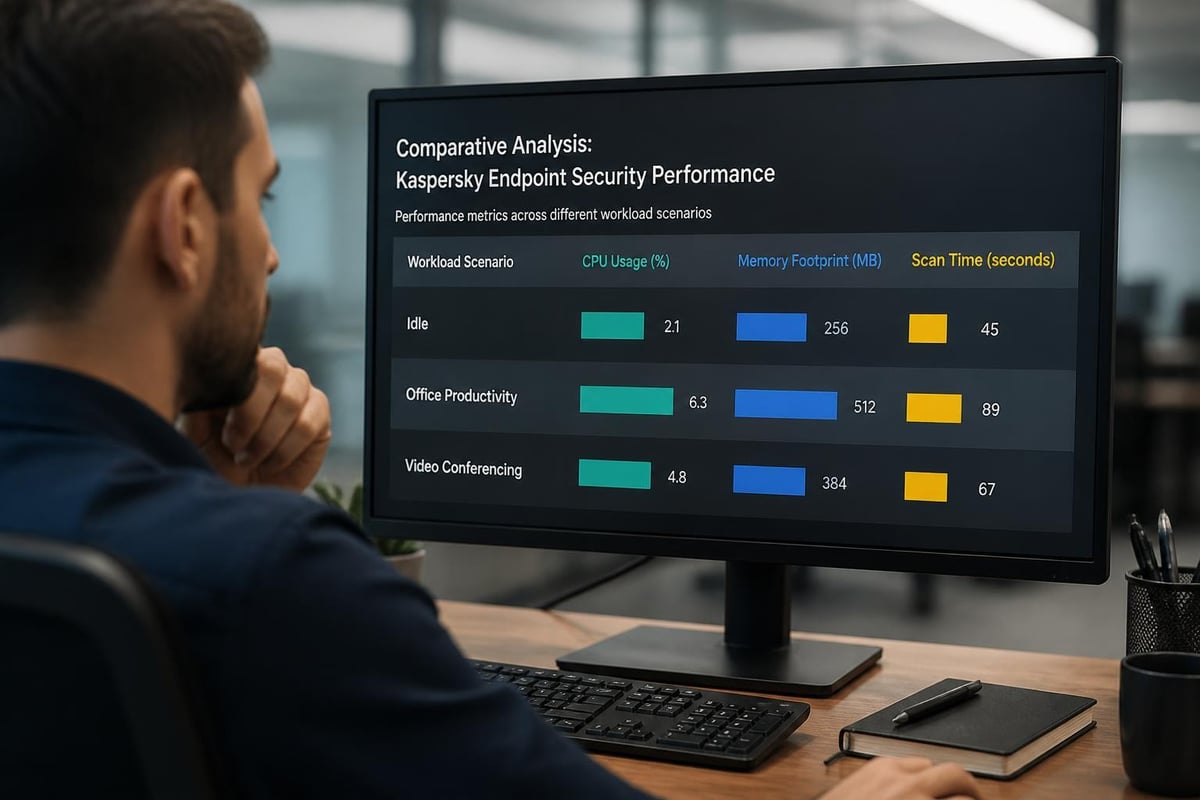
The ultimate measure of endpoint security effectiveness is its ability to detect and block threats in production environments. Kaspersky endpoint security demonstrates strong performance against both commodity malware and sophisticated targeted attacks.
AV-Comparatives Business Security Test results from August through November 2024 show Kaspersky achieving 99.9% protection rates against real-world threats while maintaining low false positive rates. These tests evaluate products against live malware samples collected in the wild rather than curated test sets.
Organizations facing nation-state actors and advanced threat groups require endpoint protection capable of identifying sophisticated multi-stage attacks. Kaspersky's research division continuously analyzes APT campaigns, publishing detailed technical reports that inform detection logic.
The quarterly APT report from Securelist for Q3 2024 documents detection and analysis of campaigns by threat actors including those targeting critical infrastructure, financial institutions, and government agencies. Kaspersky endpoint security incorporates indicators and behavioral patterns from these investigations into its detection engines.
APT detection relies on multiple data sources:
When endpoint agents detect APT indicators, they automatically collect forensic artifacts and alert security operations teams through the management console. Administrators can initiate remote investigations, capture memory dumps, and isolate compromised systems without physical access.
Enterprise security teams operate complex toolchains that span SIEM platforms, threat intelligence feeds, vulnerability management systems, and incident response workflows. Kaspersky endpoint security provides integration points that connect endpoint telemetry with broader security operations.
The platform supports SIEM integration through syslog forwarding and API-based event streaming. Security teams can correlate endpoint events with network security alerts, authentication logs, and cloud service activity to identify complex attack patterns spanning multiple systems.
Threat intelligence sharing enables bidirectional communication between endpoint protection and external threat feeds. Organizations can import custom indicators of compromise (IOCs) from industry sharing groups or proprietary research, automatically blocking known-bad artifacts across all managed endpoints.
| Integration Type | Use Case | Protocol/Method |
|---|---|---|
| SIEM | Centralized logging and correlation | Syslog, CEF, API |
| Threat Intelligence | IOC sharing and automated blocking | STIX/TAXII, OpenIOC, CSV |
| Ticketing | Automated incident creation | REST API, webhooks |
| Vulnerability Management | Coordinated patching workflows | API, scheduled reports |
Modern security architectures embrace Zero Trust principles that eliminate implicit trust based on network location. Kaspersky endpoint security supports Zero Trust implementations through continuous verification and least-privilege enforcement.
The platform provides device health attestation that validates endpoint compliance before granting network access. This integration works with network access control (NAC) systems and software-defined perimeter solutions to enforce policy-based segmentation. As outlined in NIST guidance on Zero Trust, endpoint security serves as a critical component of identity-based access control.
Application control and privilege management features implement least-privilege principles at the endpoint level. Users operate with standard permissions while the security agent mediates access to sensitive resources based on context including user identity, device health, and application legitimacy.
Unpatched vulnerabilities represent a persistent endpoint security challenge as attackers exploit known flaws faster than organizations can deploy updates. Kaspersky endpoint security includes vulnerability assessment capabilities that identify missing patches and misconfigurations across managed devices.
The vulnerability scanner inventories installed software, compares versions against Kaspersky’s vulnerability database, and prioritizes remediation based on exploitability and business impact. Administrators receive detailed reports showing which endpoints require specific patches and can schedule automated deployment during maintenance windows.
Just as physical security installations require regular assessment and updates, endpoint security demands continuous monitoring. Organizations that invest in comprehensive physical security measures like burglar guards understand the importance of proactive protection layers. Limax Burglar Guards deliver custom-fitted aluminum window security that combines strength with aesthetics, providing 24/7 protection against unauthorized access. Similarly, endpoint security requires defense-in-depth strategies where multiple controls work together to prevent breaches.

Even with rigorous patching, zero-day vulnerabilities emerge regularly. Kaspersky endpoint security implements exploit prevention modules that protect applications from attack techniques before vendors release patches.
Protected application categories include:
These protections monitor application behavior for exploit indicators including heap spraying, DEP bypass attempts, and abnormal memory operations. When exploit activity is detected, the security agent terminates the process and logs forensic details for investigation.
Endpoint security extends beyond traditional workstations to encompass smartphones, tablets, and other mobile devices that access corporate resources. Kaspersky endpoint security provides unified management for heterogeneous device fleets including iOS, Android, Windows, and macOS endpoints.
Mobile device management (MDM) capabilities allow organizations to enforce security policies on personal and corporate-owned devices. Administrators can require encryption, configure VPN settings, distribute certificates, and remotely wipe lost or stolen devices. Containerization technology separates corporate applications and data from personal content on BYOD devices.
Security teams benefit from consistent policy frameworks across operating systems rather than managing separate tools for each platform. Kaspersky endpoint security provides unified policy templates that translate platform-appropriate controls across Windows, macOS, Linux, and mobile operating systems.
This consistency extends to threat detection where the same behavioral analysis principles apply regardless of underlying operating system. While implementation details vary by platform, the security model remains coherent across the endpoint estate.
Independent testing provides objective validation of security product capabilities, but understanding test methodologies is essential for interpreting results. Organizations should examine both what is tested and what gaps remain in standardized evaluation frameworks.
The SANS Institute white paper on endpoint detection and response discusses EDR evaluation criteria and architectural considerations for enterprise deployments. Traditional antivirus tests measure malware detection but may not fully assess EDR capabilities including threat hunting, forensics, and incident response workflows.
Academic analysis of MITRE Engenuity ATT&CK evaluations highlights methodology strengths and limitations when interpreting vendor performance. These evaluations test detection coverage across adversary tactics and techniques but represent specific threat scenarios rather than comprehensive security validation.
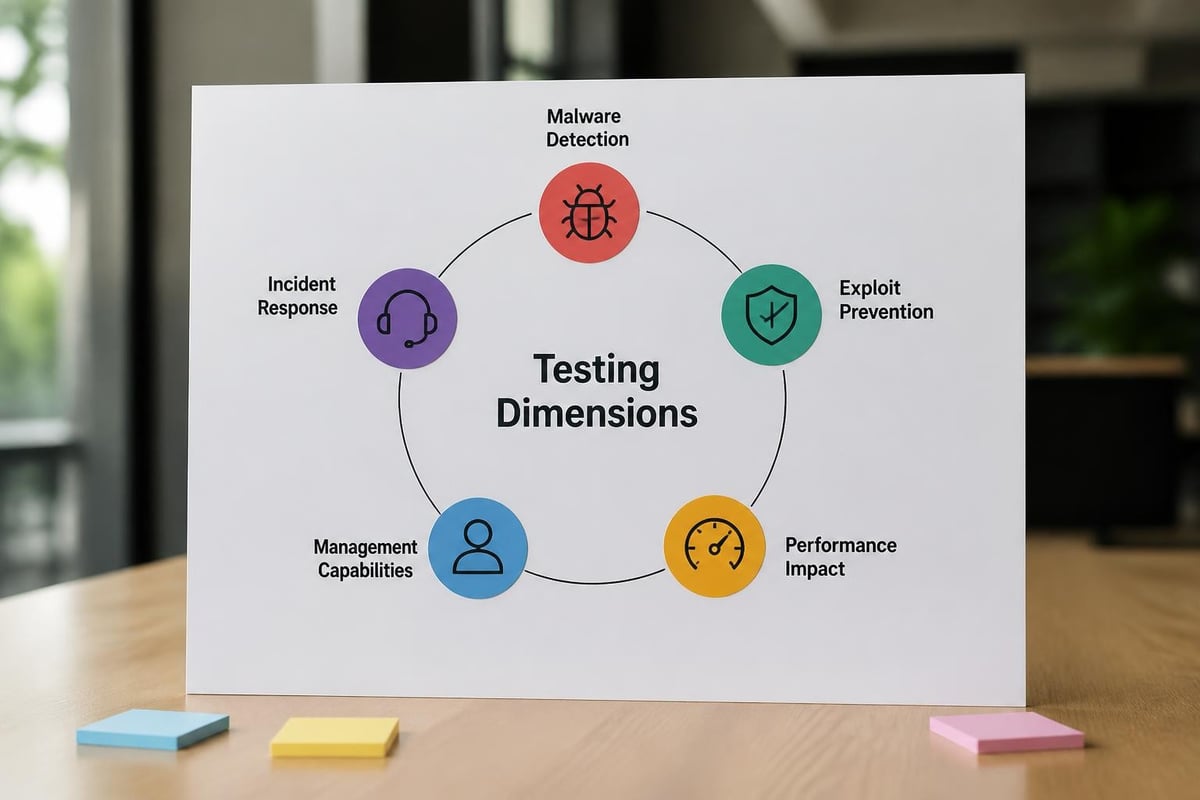
Organizations should review multiple independent test sources and consider their specific threat profile when evaluating endpoint protection platforms. Financial services firms facing targeted attacks may prioritize APT detection over commodity malware blocking, while retail environments focus on point-of-sale protection.
When prevention fails, rapid detection and response minimize breach impact. Kaspersky endpoint security includes forensic tools that help security teams investigate incidents, understand attack scope, and remediate compromised systems.
The Incident Response module provides remote access to endpoint forensic data including process execution history, network connections, file system modifications, and registry changes. Analysts can search across thousands of endpoints simultaneously to identify indicators of compromise and trace attacker lateral movement.
Automated response actions include:
Timeline reconstruction visualizes attack progression showing initial compromise, privilege escalation, lateral movement, and data exfiltration activities. These forensic artifacts support both remediation efforts and post-incident analysis to strengthen defenses against similar future attacks.
Successful endpoint security deployments require careful planning that accounts for organizational structure, existing infrastructure, and operational constraints. Organizations should develop phased rollout strategies that validate functionality before full-scale deployment.
Recommended deployment phases:
Migration from existing endpoint protection solutions requires coexistence planning to prevent conflicts. Kaspersky endpoint security can detect and coordinate with incumbent solutions during transition periods, allowing gradual replacement without protection gaps.
Endpoint security represents a significant ongoing investment beyond initial licensing costs. Organizations should evaluate total cost of ownership including licensing, infrastructure, administrative overhead, and operational impact.
| Cost Component | Consideration Factors |
|---|---|
| Licensing | Per-device vs. per-user, term length, volume discounts |
| Infrastructure | On-premises servers, cloud hosting, bandwidth consumption |
| Administration | Management time, training requirements, integration effort |
| Performance | User productivity impact, hardware upgrade needs |
| Support | Vendor support tiers, incident response services |
Kaspersky offers flexible licensing options including subscription-based models that provide predictable annual costs and automatic entitlement to new features. Organizations can choose term lengths from one to three years with discounts for longer commitments and larger deployments.
Organizations in regulated industries must ensure endpoint security solutions meet compliance requirements for data protection, audit logging, and incident reporting. Kaspersky endpoint security provides compliance-oriented features including detailed audit trails, encryption key management, and data loss prevention.
Financial institutions subject to PCI DSS requirements can leverage file integrity monitoring, application whitelisting, and change control features to satisfy technical control mandates. Healthcare organizations meeting HIPAA standards benefit from encryption enforcement, device control, and access logging capabilities.
Data residency considerations affect deployment architecture for multinational organizations. Kaspersky Security Center supports distributed deployment models where regional management servers maintain data sovereignty while participating in global threat intelligence sharing through controlled channels.
Kaspersky endpoint security delivers comprehensive protection through layered defenses, flexible deployment options, and proven detection capabilities validated by independent testing. Organizations seeking robust endpoint protection should evaluate the platform's feature set against their specific threat profile, operational requirements, and integration needs. When you need physical security that complements your digital defenses, Limax Security Specialists provides professional installation of security gates, burglar bars, roller shutters, and comprehensive security solutions designed to protect South African homes and businesses with the same multi-layered approach that defines effective cybersecurity.


