
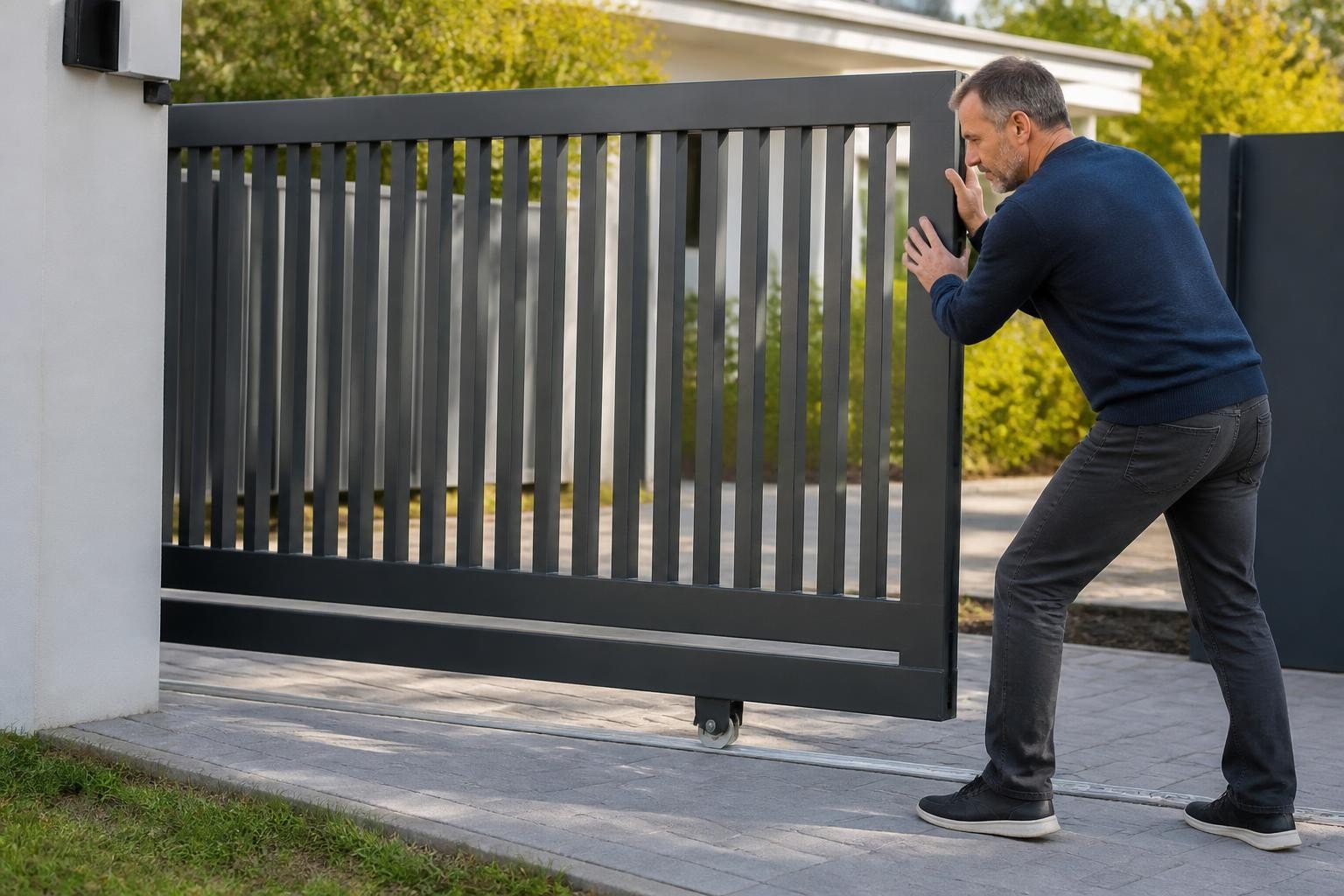
Manual sliding driveway gates offer property owners a practical, cost-effective solution for controlling vehicular access without the complexity or expense of automated systems. Unlike swing gates that require clearance space to open inward or outward, sliding gates travel horizontally along a track, making them ideal for properties with limited driveway depth or sloped terrain. For residential and commercial installations across South Africa, these gates deliver robust security, weather resistance, and long-term reliability while keeping operational costs minimal. Understanding the design principles, installation requirements, and maintenance needs of manual sliding driveway gates helps property owners make informed decisions that balance security, functionality, and budget.
Manual sliding driveway gates operate on a straightforward mechanical principle: the gate panel moves laterally along a ground track or overhead rail, guided by rollers or wheels. The cantilever design, which suspends the gate above the driveway surface without a ground track, represents the premium option but requires more complex engineering and structural support.
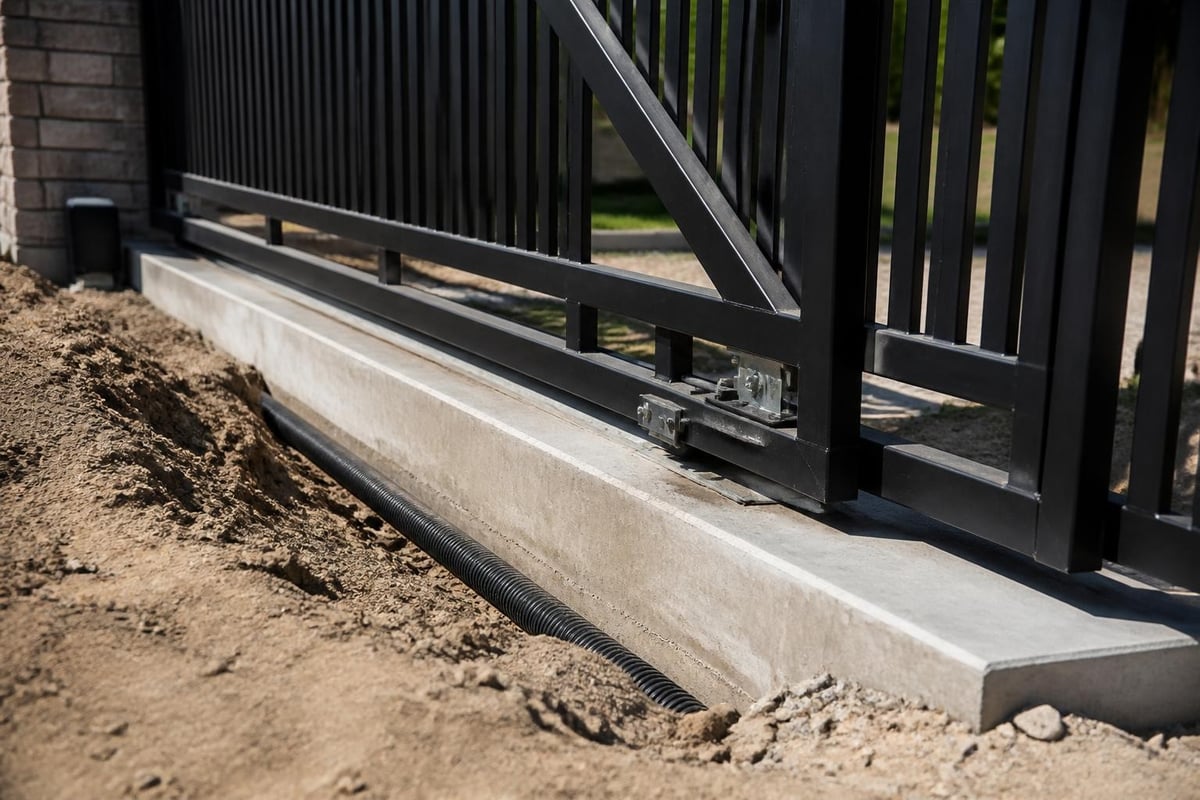
Track-mounted systems anchor a steel or aluminum channel to the driveway surface, and the gate's bottom rollers travel within this track. This configuration offers excellent stability and load distribution, making it suitable for heavy gates up to several hundred kilograms. The track must be installed level and embedded in concrete to prevent shifting under repeated use.
Cantilever gates eliminate the ground track entirely, suspending the gate from a wheeled carriage that travels along an overhead or rear-mounted beam. This design prevents snow, debris, or uneven surfaces from interfering with operation, but it demands a robust structural frame and substantial cantilever counterweight beyond the gate opening.
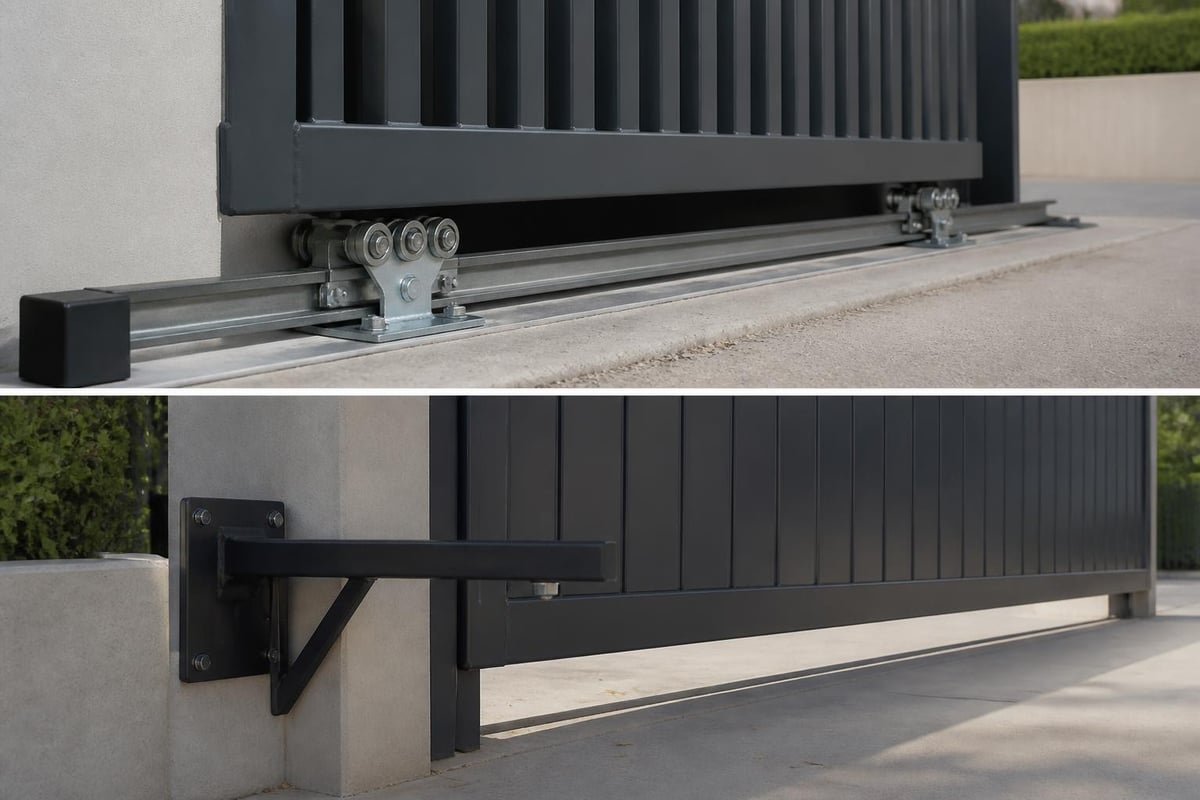
Gate frames typically use galvanized steel, aluminum, or powder-coated steel tube. Steel provides maximum strength and rigidity for wide spans (4 to 8 meters), while aluminum reduces weight and eliminates rust concerns in coastal or high-humidity environments. The ASTM F2200 standard establishes minimum requirements for gate construction, including material specifications, welding quality, and structural integrity testing for vehicular gates.
Most manual sliding driveway gates feature a rectangular tube-steel perimeter with vertical or horizontal infill bars, mesh panels, or decorative elements. The infill design affects wind loading, visibility, and aesthetic compatibility with existing perimeter fencing. Solid-panel gates made from steel sheet or composite materials resist wind forces differently than open-bar designs, requiring careful engineering to prevent gate deflection or track misalignment.
Proper installation begins with accurate site measurement and thorough ground preparation. The gate opening width, available run-back space, and driveway slope all influence design decisions and component selection.
Manual sliding driveway gates require run-back space equal to at least 110 percent of the gate opening width. A 4-meter opening, for example, needs approximately 4.4 meters of clear space alongside the driveway for the gate to slide fully open. Property boundaries, landscaping, utility boxes, and structural obstacles must all be accounted for during the planning phase.
Driveway slope presents additional challenges. Gates operating on inclines require gravity-assist catch mechanisms to prevent rolling, plus secure latching systems that hold the gate firmly when closed. The track installation must account for drainage to prevent water pooling, which can freeze in winter climates or accelerate corrosion in steel components.
| Installation Component | Purpose | Typical Specification |
|---|---|---|
| Ground track | Guides gate rollers | 3-4m galvanized steel channel |
| Concrete foundation | Anchors track and posts | 300-500mm depth, reinforced |
| Support posts | Bears gate weight | 100x100mm steel tube, 1.5m+ embedment |
| Rollers/wheels | Enable gate movement | Steel or nylon, sealed bearings |
| Catch/latch system | Secures gate when closed | Drop-bolt or hook latch |
The gate's support post and track foundation form the structural backbone of the installation. For track-mounted systems, excavate a trench along the gate's travel path, typically 300 to 500 millimeters deep and 200 millimeters wide. Pour reinforced concrete around the embedded track channel, ensuring precise leveling and alignment with the driveway surface.
The primary support post (where the gate latches when closed) must extend at least 1.5 meters below grade in a concrete footing, sized to resist lateral forces from wind loading and accidental vehicle impact. According to ASCE 7 structural design principles, wind pressure on large gate panels can exceed 1.4 kPa in exposed locations, translating to several hundred kilograms of lateral force on a 4-meter-wide gate.
Manual sliding driveway gates rely on quality hardware to deliver smooth, reliable operation over years of daily use. Component selection directly impacts the effort required to open and close the gate, as well as long-term maintenance costs.
Gate rollers bear the full weight of the gate panel while minimizing friction during lateral movement. Heavy-duty nylon or polyurethane rollers offer quiet operation and corrosion resistance, while sealed ball-bearing rollers provide the lowest rolling resistance for large, heavy gates. A typical 150-kilogram gate requires at least four rollers rated for 50 kilograms each, plus a safety margin.
Adjustable roller brackets allow fine-tuning of gate height and track alignment after installation. This adjustability compensates for minor foundation settling or seasonal ground movement that can affect gate operation. V-groove rollers that ride within the track channel prevent lateral wobble and keep the gate aligned even on windy days.
Secure latching is critical for both security and gate stability. Drop-bolt latches use a vertical pin that falls into a ground-mounted receiver when the gate reaches the closed position. This design provides positive locking and prevents wind from pushing the gate open, but it requires precise alignment between the bolt and receiver.
Horizontal hook latches engage a loop or catch mounted on the fixed post, pulling the gate tight against a rubber bumper. These latches work well on sloped driveways where gravity might otherwise pull the gate downhill. For security-conscious installations, integrate a padlock hasp or cylinder lock into the latch mechanism to prevent unauthorized opening.
Even manual gates present entrapment and impact hazards that property owners must address. Understanding applicable safety standards helps prevent accidents and ensures compliance with local building codes.
The International Code Council has incorporated gate-safety provisions based on ASTM gate standards into recent editions of the International Building Code and International Residential Code. These provisions address entrapment risks at closing edges, gate-to-post gaps, and under-gate clearances.
Manual sliding driveway gates must maintain minimum spacing between the gate edge and fixed posts or walls. Gaps narrower than 50 millimeters prevent finger entrapment, while gaps wider than 200 millimeters allow a trapped limb to withdraw. The intermediate range (50 to 200 millimeters) presents the highest injury risk and should be avoided through careful design or protective guards.
The American Fence Association recommends specific gap-size testing using calibrated spheres to verify that gate designs meet safety standards. A 125-millimeter sphere should not pass through any opening in the gate or between the gate and fixed structures in areas accessible to children.
Large manual sliding driveway gates that block pedestrian walkways require an integrated pedestrian gate or separate pedestrian access point. Forcing pedestrians to manually slide a heavy gate for foot traffic creates inconvenience and potential safety issues. A lockable pedestrian gate within or adjacent to the main gate provides convenient access while maintaining perimeter security.
Reflective strips or bright paint on the gate's closing edge improve visibility for drivers approaching from inside the property, reducing the risk of vehicle impact during gate operation. Consider sight lines from the driver's position when designing gate infill patterns, ensuring adequate visibility of approaching traffic or pedestrians.
Manual sliding driveway gates require less maintenance than automated systems but still benefit from periodic inspection and service to ensure smooth operation and extend component life.
Quarterly inspections should cover these critical areas:
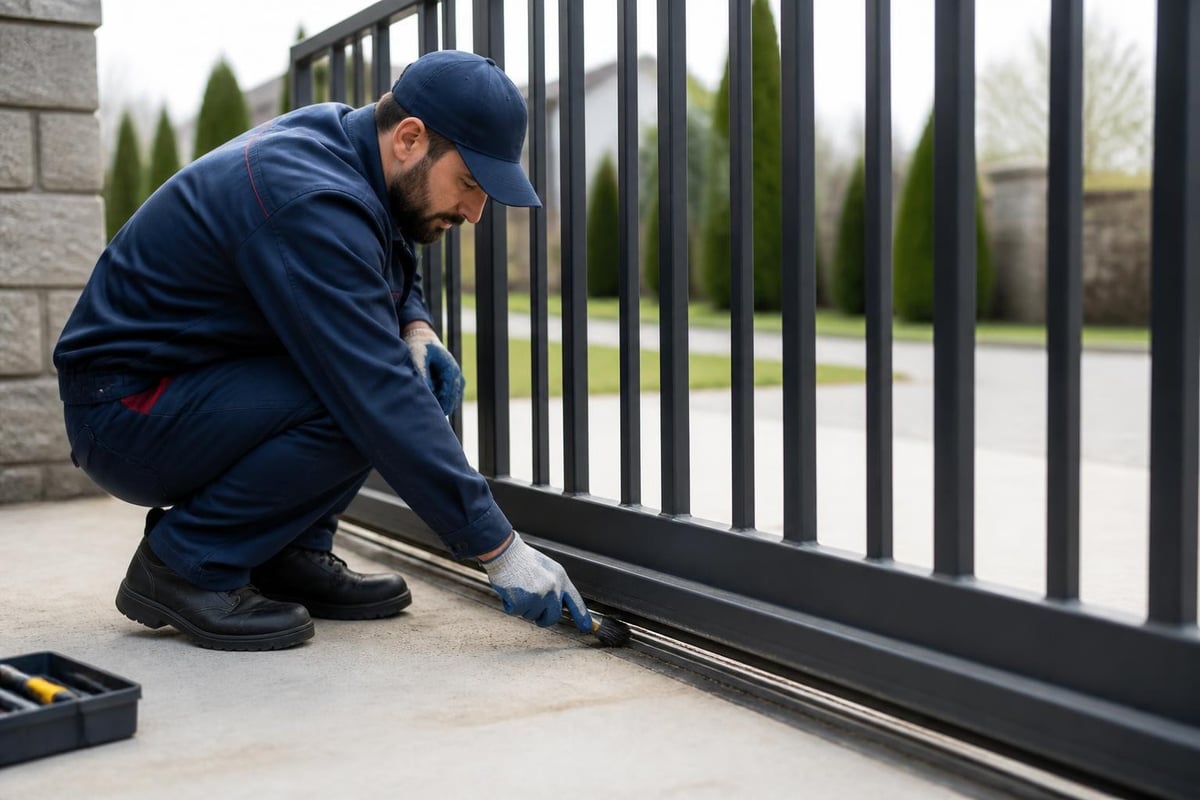
Track cleaning is particularly important in dusty environments or areas with falling leaves and organic debris. A wire brush and shop vacuum effectively remove accumulated material that increases rolling resistance. Flush the track channel with water periodically to prevent sediment buildup that can cause roller damage.
Apply light machine oil or silicone lubricant to roller bearings every six months, or more frequently in coastal areas where salt air accelerates corrosion. Avoid heavy greases that attract dust and debris, creating an abrasive paste that damages bearings and track surfaces.
Powder-coated and galvanized finishes protect steel components from rust, but scratches and paint chips expose bare metal to moisture. Touch up damaged areas promptly with rust-inhibiting primer and matching topcoat. For aluminum gates, inspect fasteners and dissimilar-metal junctions where galvanic corrosion can occur, applying dielectric grease to vulnerable connections.
Manual sliding driveway gates form one layer in a comprehensive property security strategy. Coordinating gate design with perimeter fencing, intrusion detection, and access control maximizes overall effectiveness.
The gate should match the height, material, and design of adjacent perimeter fencing to eliminate weak points or visual discontinuity. A 2-meter-high security fence loses effectiveness if paired with a 1.5-meter gate that invites climbing or vaulting. Extending palisade or spike-top fencing across the gate panel maintains security continuity.
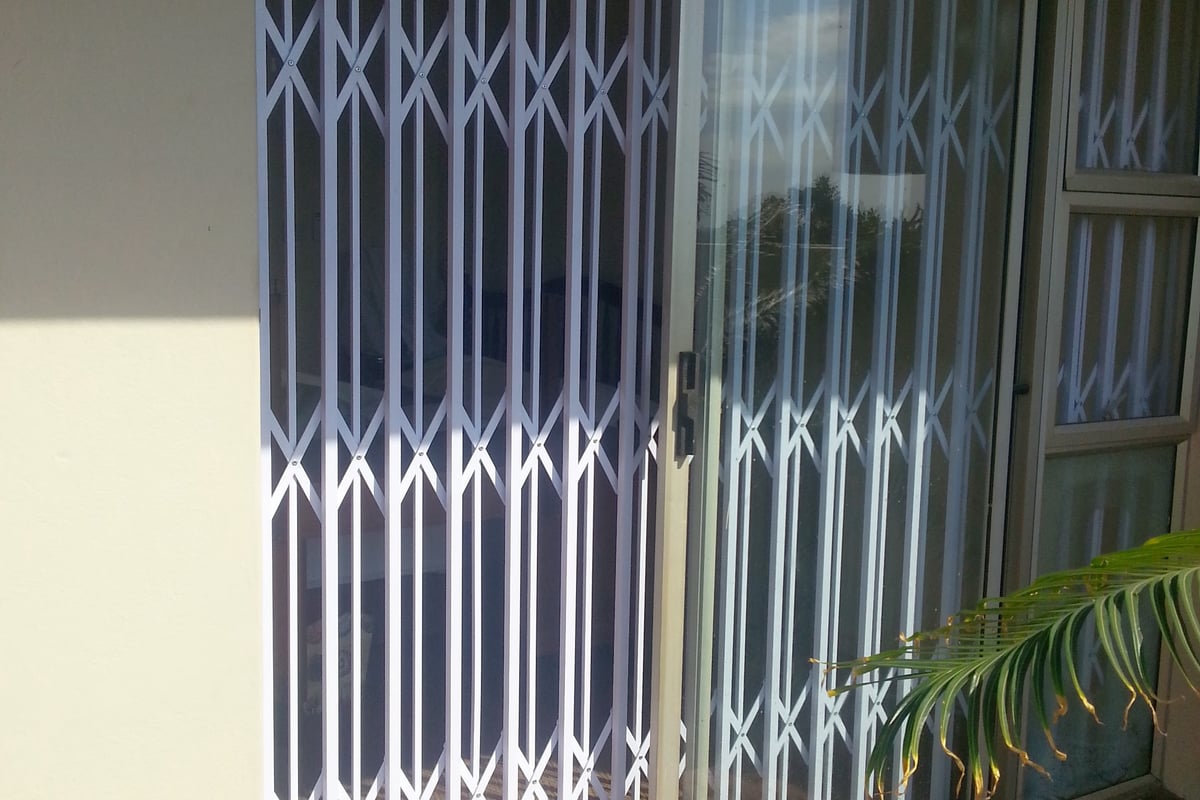
For properties with existing security gates on pedestrian entrances, coordinate the sliding gate's aesthetic to create a unified security appearance. Consistent color schemes, bar spacing, and design motifs reinforce the property's security posture while enhancing curb appeal.
Limax Security Specialists manufactures custom sliding driveway gates that integrate seamlessly with Crime-Stopper and Monkey-Proof Security Gates, ensuring your vehicular access points provide the same robust protection as your pedestrian entrances.
While manual gates lack automatic operators, they can still integrate with modern security technology. Magnetic contacts mounted on the gate and fixed post detect when the gate opens, triggering alerts to security systems or mobile devices. This simple addition provides real-time notification of gate operation even when property owners are away.
Although primarily designed for automated systems, laser sensors and photoelectric beams can still benefit manual installations by alerting users to obstructions in the gate's path. The BEA LZR-H100 application guide demonstrates how modern detection technology prevents gate-related accidents by warning operators of vehicles, pedestrians, or objects in the travel path.
Manual sliding driveway gates offer significant cost advantages over automated systems while retaining the option for future automation when budget allows.
A quality manual sliding gate installation typically costs 40 to 60 percent less than a comparable automated system. Eliminating the gate operator, control panel, safety sensors, and electrical installation reduces both equipment and labor expenses. For budget-conscious property owners or remote locations without reliable electrical supply, manual operation provides full security functionality without ongoing electricity costs or operator maintenance.
| Cost Component | Manual System | Automated System |
|---|---|---|
| Gate panel and hardware | $1,500 – $3,500 | $1,500 – $3,500 |
| Installation labor | $800 – $1,500 | $1,200 – $2,500 |
| Operator and controls | $0 | $1,200 – $3,000 |
| Electrical installation | $0 | $500 – $1,500 |
| Safety sensors | $0 | $300 – $800 |
| Annual maintenance | $100 – $200 | $250 – $500 |
Total ownership cost over ten years favors manual systems in most scenarios, particularly for residential properties with moderate traffic volume. Commercial facilities with high daily vehicle throughput may justify automation costs through improved convenience and traffic flow, but manual systems remain cost-effective for many applications.
Specify "automation-ready" design features even if immediate installation uses manual operation. Oversized gate posts with internal conduit accommodate future operator mounting and wiring. Track systems compatible with rack-and-pinion or chain-drive operators allow straightforward automation retrofits without structural modifications.
When automation becomes desirable, UL 325-compliant operators ensure proper safety features including entrapment protection, emergency release, and monitored safety inputs. The DASMA technical guidance provides industry-standard recommendations for operator selection, safety device installation, and testing procedures that apply when converting manual gates to automatic operation.
South Africa's diverse climate zones demand gate designs that withstand intense sun, coastal salt spray, seasonal temperature swings, and occasional severe weather events.
Wide sliding gates present substantial surface area to wind forces, particularly solid-panel designs or gates with minimal open area. Engineering calculations based on ASCE 7 wind-load standards determine required structural strength for gate frames, support posts, and foundation anchors.
In coastal areas prone to strong winds, specify heavier-gauge steel tube for gate frames (minimum 50x50x3mm wall thickness) and increase foundation depth to 600 millimeters or more. Open-bar designs reduce wind loading compared to solid panels, but they must still meet strength requirements for lateral stability during gate operation in windy conditions.
Coastal installations within five kilometers of saltwater require enhanced corrosion protection. Hot-dip galvanizing provides superior rust resistance compared to paint or powder coating alone, though galvanized surfaces should receive additional topcoating for aesthetic purposes and enhanced protection. Stainless-steel fasteners, hinges, and latch components eliminate the most common corrosion failure points in gate assemblies.
For inland properties with lower corrosion risk, powder-coated mild steel offers excellent durability at lower cost than galvanized or stainless materials. Ensure powder coating reaches minimum 80-micron thickness with proper surface preparation (phosphate treatment or sandblasting) before application.
Manual sliding driveway gates significantly influence property curb appeal and market value. Thoughtful design coordination with architectural style enhances rather than detracts from property aesthetics.
Contemporary homes pair well with horizontal-bar gates in contrasting colors (black on white walls, bronze on natural stone). Traditional or colonial architecture suggests vertical picket designs or ornamental scrollwork that echoes existing ironwork details. Industrial or modern farmhouse styles accommodate metal mesh panels or corrugated infill for texture and visual interest.
Laser-cut decorative panels insert custom patterns, logos, or geometric designs into the gate face, creating distinctive focal points. These panels function as removable cassettes within the structural frame, allowing pattern updates or repairs without replacing the entire gate. Privacy-oriented designs use offset slats or perforated metal that block direct sight lines while permitting airflow and partial visibility.
Black remains the most popular gate color for its versatility and traditional appeal, but charcoal, bronze, and dark green offer sophisticated alternatives. Light colors (white, cream, silver) suit Mediterranean or coastal architectural styles but show dirt accumulation more readily than dark finishes. Dual-tone designs with contrasting frame and infill colors add visual depth.
Powder-coat finishes deliver superior durability and color retention compared to liquid paints, with most manufacturers offering warranties of five to ten years against fading, chalking, or peeling. Specify UV-resistant formulations for exposed installations in high-sun areas to minimize color degradation over time.
Even well-designed manual sliding driveway gates occasionally develop operational problems. Most issues stem from alignment changes, wear, or debris accumulation that property owners can address without professional service.
Increased resistance when opening or closing the gate indicates track contamination, roller wear, or foundation settlement. Clean the track thoroughly, inspect rollers for flat spots or seized bearings, and verify that the track remains level. Measure gate height at multiple points along its length; variations exceeding 10 millimeters suggest foundation movement requiring professional assessment.
Check for contact between the gate bottom and the track or ground. A properly adjusted gate should clear the track by 5 to 10 millimeters to prevent dragging during operation. Adjust roller brackets incrementally, testing operation after each adjustment to identify the optimal height setting.
Latches that fail to engage smoothly indicate vertical or horizontal misalignment between the gate's latch bolt and the receiving bracket. Loosen the receiver mounting bolts, align it precisely with the latch bolt path, and retighten securely. Some latch systems include adjustment slots that allow vertical or horizontal repositioning without drilling new mounting holes.
Gravity-drop latches require the gate to travel to an exact position before the drop bolt aligns with the ground receiver. Mark the correct gate position with paint or tape on the track as a visual guide, and adjust gate stops if necessary to ensure consistent positioning.
Certain properties present unique challenges requiring custom engineering or specialized gate designs beyond standard residential installations.
Farms and equestrian facilities need gates wide enough for tractors, trailers, and large agricultural equipment. Span widths from 6 to 10 meters require reinforced frames, multiple roller carriages, and substantial support structures. For these applications, cantilever designs often prove more practical than track-mounted systems, eliminating ground-level obstructions that interfere with equipment clearance.
Animal-proof designs prevent livestock or wildlife from opening latches or squeezing through gaps. Specify secure latching with keyed locks and eliminate horizontal rails or footholds that climbing animals can exploit. Bottom clearance should not exceed 100 millimeters to prevent smaller animals from passing beneath the gate.
Properties in flood zones require elevated track installations or cantilever systems that minimize ground-level components vulnerable to water damage. Specify marine-grade stainless steel or hot-dip galvanized components throughout, and design drainage systems that prevent standing water in track channels.
Consider seasonal flooding when sizing foundations and support posts. Posts extending below the flood level should receive concrete sealing and cathodic protection to prevent undermining and corrosion during inundation periods.
Manual sliding driveway gates deliver robust security, space efficiency, and reliable operation without the complexity or costs of automation. From careful site preparation and quality hardware selection through regular maintenance and weather protection, attention to design and installation details ensures decades of dependable service. Whether you're securing a residential estate, commercial facility, or specialized agricultural property, Limax Security Specialists provides expert consultation, custom fabrication, and professional installation services that integrate manual sliding gates seamlessly with your comprehensive security strategy.


