

Modern cybersecurity demands more than traditional port-and-protocol filtering. Organizations today face sophisticated threats that exploit legitimate applications, encrypted traffic, and cloud services to bypass perimeter defenses. The Palo Alto next generation firewall addresses these challenges by shifting from basic packet inspection to application-aware, identity-based security enforcement that provides visibility and control across the entire attack surface.
Traditional firewalls operate at the network layer, making permit-or-deny decisions based on IP addresses, ports, and protocols. This approach fails against modern threats because attackers tunnel malicious payloads inside permitted applications or use non-standard ports. The Palo Alto next generation firewall fundamentally reimagines this model.
Rather than inspecting traffic multiple times with different engines, Palo Alto Networks engineered SP3 architecture to perform all security functions in a single pass. The system classifies traffic, identifies applications, decrypts SSL/TLS sessions, checks for threats, applies URL filtering, and enforces data loss prevention policies simultaneously.
Key architectural advantages include:
This architecture becomes critical when defending against multi-vector attacks that combine application exploits, malware delivery, and command-and-control communications within the same session.
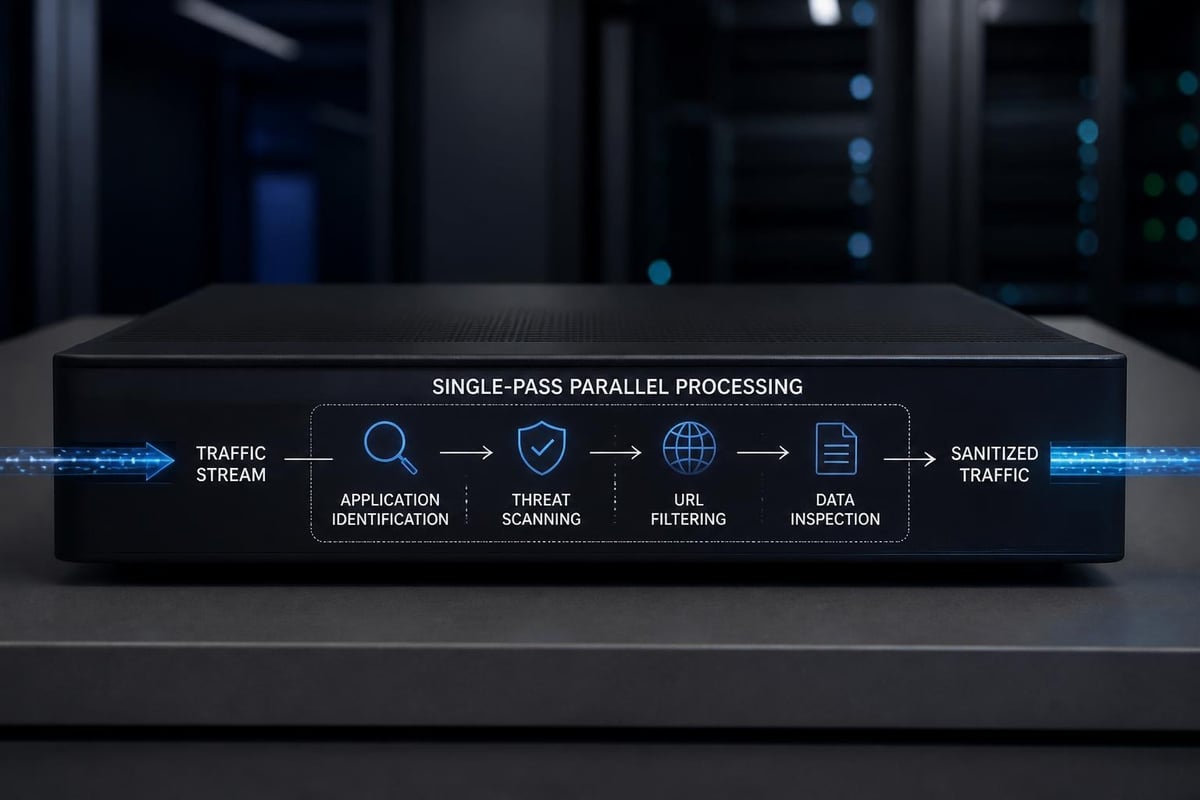
The defining characteristic of any Palo Alto next generation firewall deployment is App-ID technology. Unlike port-based filtering that assumes port 80 means HTTP, App-ID examines the actual application signatures, decodes protocols, and uses behavioral heuristics to identify what's truly running on the network.
The system employs a four-step process to classify every session. First, it checks for known application signatures by examining packet headers, transaction patterns, and protocol commands. Second, it performs SSL/TLS decryption to inspect encrypted sessions. Third, it analyzes application protocols and decoders to understand complex, multi-function apps. Finally, it applies heuristic analysis for unknown or custom applications.
| Classification Method | Use Case | Example |
|---|---|---|
| Signature match | Known commercial apps | Microsoft 365, Salesforce, Slack |
| Protocol decoder | Standard protocols | HTTP/2, QUIC, WebSocket |
| SSL inspection | Encrypted sessions | HTTPS banking, encrypted file transfer |
| Heuristic analysis | Custom/unknown apps | Internal business tools, new SaaS |
This granular visibility enables security teams to write policies based on actual application behavior rather than guessing what might traverse a particular port. According to the official Palo Alto Networks NGFW documentation, App-ID recognizes over 6,500 applications and continuously updates its signature database.
Once classified, administrators can create highly specific rules. Instead of "allow all traffic on port 443," policies become "allow Salesforce for Sales team but block file uploads" or "permit Zoom video but deny screen sharing for guests." This application-aware approach prevents shadow IT, enforces acceptable use, and reduces the attack surface by denying unnecessary application functions.
A Palo Alto next generation firewall bundles multiple threat prevention engines into the same platform. These engines share threat intelligence and inspection context, creating defense-in-depth without requiring separate appliances or complex integrations.
The threat prevention subscription includes intrusion prevention (IPS), anti-malware, anti-spyware, and vulnerability protection. The IPS engine blocks known exploits targeting server and client vulnerabilities, while anti-malware uses both signature and behavioral analysis to detect file-based threats.
Critical threat prevention features:
The platform receives automated updates multiple times per day, ensuring protection against emerging threats without manual intervention. This continuous learning model addresses the QUIC protocol evasion techniques and other modern challenges that traditional firewalls cannot adequately inspect.

The Palo Alto next generation firewall serves as a foundational element in Zero Trust architectures by enabling granular segmentation and identity-aware policy enforcement. Organizations moving beyond flat networks implement micro-segmentation to contain lateral movement and reduce blast radius during incidents.
The platform integrates with Active Directory, LDAP, SAML, and other identity sources to map network traffic to specific users and groups. Policies then enforce rules based on who is accessing resources, not just where packets originate. A finance employee working remotely receives different application access than a contractor on the same VPN, even if both authenticate successfully.
Physical security installations share similar layered defense principles. Just as Monkey-Proof Security Gates combine robust materials, intelligent design, and specialized barriers to prevent unauthorized entry while maintaining aesthetic appeal, the firewall employs multiple inspection layers to stop threats without blocking legitimate business functions. Both approaches recognize that comprehensive protection requires more than a single barrier.

Network segmentation divides environments into smaller zones with strict inter-zone policies. The CISA enhanced visibility and hardening guidance specifically recommends this approach for critical infrastructure and communications systems.
Common segmentation patterns include:
The Palo Alto next generation firewall enforces policies between these zones using App-ID and User-ID, ensuring that even compromised credentials cannot access unauthorized segments.
Over 90% of internet traffic now uses encryption, creating a visibility gap that attackers exploit. Malware, command-and-control channels, and data exfiltration hide inside encrypted sessions, passing through traditional firewalls undetected.
The Palo Alto next generation firewall intercepts SSL/TLS sessions, decrypts the payload, performs full threat inspection, and re-encrypts traffic before forwarding. This process requires certificate management and computational resources but provides essential visibility into encrypted threats.
Decryption policy considerations:
Organizations should reference NIST Guidelines on Firewalls and Firewall Policy when designing decryption policies to balance security visibility with privacy obligations.
The firewall platform extends beyond on-premises appliances through cloud-delivered security services that enhance protection and simplify management. These services leverage global threat intelligence, machine learning infrastructure, and elastic cloud resources.
For distributed workforces and cloud applications, the Palo Alto next generation firewall integrates with Prisma Access, delivering NGFW capabilities as a cloud service. Remote users connect to the nearest Prisma Access point-of-presence, receiving consistent security policies regardless of location.
| Deployment Model | Use Case | Security Functions |
|---|---|---|
| Hardware appliance | Data center perimeter | Full NGFW, VPN termination, internet gateway |
| VM-Series | Private/public cloud | East-west segmentation, cloud workload protection |
| CN-Series | Kubernetes | Container traffic inspection, pod-level policies |
| Prisma Access | Remote users, branches | ZTNA, CASB, SWG, NGFW-as-a-service |
This multi-form-factor approach ensures the same security policies apply whether traffic flows through a branch office, headquarters data center, AWS VPC, or employee home network.
Complex security platforms fail when administrators cannot effectively configure, monitor, and maintain them. The Palo Alto next generation firewall addresses operational challenges through centralized management, automation, and policy optimization tools.
Panorama provides a single console for managing hundreds or thousands of firewalls across global deployments. Administrators create template configurations, push policy changes, aggregate logs, and generate compliance reports from one interface.
Automation capabilities include:
The CIS Benchmark for Palo Alto Networks provides hardening guidance that organizations can implement through Panorama templates, ensuring consistent security posture across the entire firewall estate.

Signature-based detection cannot keep pace with polymorphic malware and zero-day exploits. The Palo Alto next generation firewall incorporates multiple machine learning models that identify malicious behavior without requiring known attack patterns.
The platform runs trained neural networks directly in the firewall data path, analyzing file characteristics and session behavior in real time. These models examine hundreds of file features simultaneously, detecting evasive malware that traditional signatures miss.
Machine learning application areas:
This approach proves particularly effective against targeted attacks and advanced persistent threats that customize toolsets for specific victims. Research published on arXiv regarding ATT&CK-based security testing demonstrates how adversarial techniques evolve faster than signature updates, making behavioral detection essential.
Enterprise networks cannot tolerate security infrastructure downtime or bottlenecks. The Palo Alto next generation firewall supports multiple high availability configurations and performance scaling options to meet demanding requirements.
Organizations deploy firewall pairs in active/passive mode for failover redundancy or active/active mode for load distribution. Session synchronization ensures that failover events maintain existing connections without disruption.
| HA Configuration | Sessions | Throughput | Use Case |
|---|---|---|---|
| Active/Passive | Synced to standby | Single unit capacity | Critical uptime, license efficiency |
| Active/Active | Load balanced | Combined capacity | High throughput, geographic redundancy |
| Clustered | Distributed | Aggregate cluster | Data center core, campus networks |
The system monitors link status, path quality, and device health continuously, triggering automatic failover based on administrator-defined thresholds.
Regulatory frameworks increasingly require organizations to demonstrate network security controls, logging capabilities, and incident response procedures. The Palo Alto next generation firewall generates comprehensive audit trails and compliance reports aligned with industry standards.
The platform supports PCI DSS requirements for network segmentation and firewall rule documentation, HIPAA logging and access control mandates, and GDPR data protection enforcement. Detailed session logs capture user identity, application, content, and threat verdicts for every connection.
Compliance reporting features:
Security teams reference these logs during incident investigations, compliance audits, and forensic analysis. The granular visibility that App-ID and User-ID provide creates an authoritative record of network activity.
Organizations replacing legacy firewalls or implementing NGFW capabilities for the first time must carefully plan migrations to avoid service disruptions or security gaps. The Palo Alto next generation firewall supports phased deployments that gradually transition from port-based to application-aware policies.
Rather than immediately blocking all unidentified applications, best practice recommends a monitor-then-enforce progression. Administrators first deploy the firewall in shadow mode, observing application usage without blocking traffic. This discovery phase reveals the actual applications traversing the network and identifies policy requirements.
Migration phases:
This measured approach prevents business disruption while steadily improving security posture. Organizations can reference existing port-based rules and use the firewall's migration tools to convert them into application-specific policies automatically.
Hardware capabilities alone do not provide complete protection. The Palo Alto next generation firewall requires active subscriptions to threat prevention, URL filtering, DNS security, and other cloud-delivered services that update continuously with new intelligence.
Palo Alto Networks offers tiered subscription bundles that combine multiple security services at different coverage levels. The Threat Prevention subscription includes IPS, anti-malware, and vulnerability protection. Advanced Threat Prevention adds Wildfire malware analysis and DNS security. Premium bundles include advanced URL filtering and IoT security.
License management through Panorama centralizes subscription renewals, activation, and compliance tracking across the entire firewall deployment. Organizations should budget for annual subscription costs in addition to hardware or VM licensing.
Modern cybersecurity threats demand application-aware, identity-based protection that traditional firewalls cannot deliver. The Palo Alto next generation firewall provides this comprehensive defense through integrated threat prevention, SSL inspection, and Zero Trust segmentation. Just as sophisticated physical security requires expert design and professional installation to protect homes and businesses effectively, network security demands equally specialized knowledge and proven solutions. Limax Security Specialists brings decades of experience securing South African properties with advanced protection systems tailored to each client's specific requirements-contact us today to discuss comprehensive security solutions for your residential or commercial property.


