

Security threats evolve faster than most organizations can respond. As cyberattacks grow in sophistication and frequency, businesses face mounting pressure to monitor networks continuously, correlate security events, and respond to incidents before damage occurs. Managed SIEM services offer a strategic answer: expert-led security information and event management that combines technology platforms with human intelligence to protect digital assets around the clock.
Managed SIEM services deliver comprehensive security monitoring by combining powerful SIEM platforms with dedicated security operations center (SOC) teams. Unlike traditional SIEM deployments that organizations configure and staff internally, managed services shift the operational burden to specialized providers who maintain the technology, write detection rules, and investigate alerts.
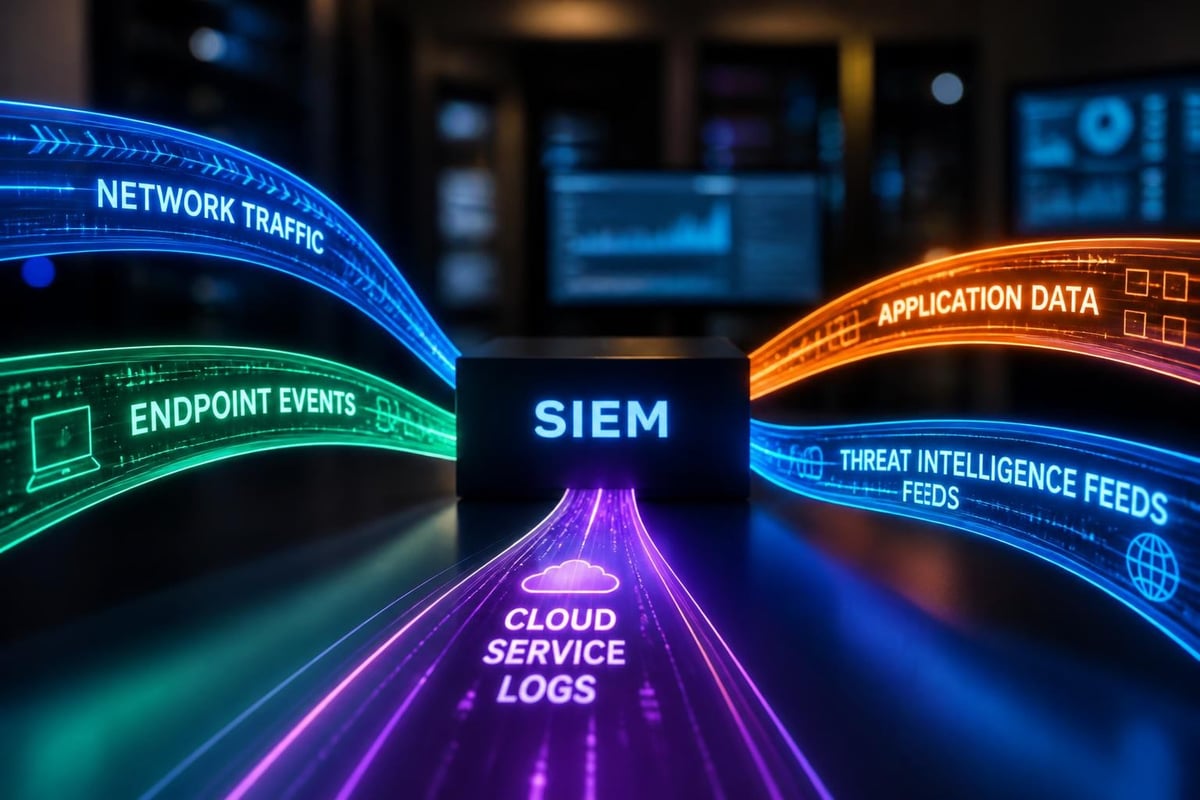
At its core, a SIEM platform collects log data from across an IT environment-firewalls, endpoints, applications, cloud services, and network devices. The system normalizes this disparate data into a unified format, then applies correlation rules and behavioral analytics to identify suspicious patterns. When the SIEM detects anomalies or known attack signatures, it generates alerts for investigation.
What transforms a SIEM platform into managed SIEM services is the dedicated team behind it. Managed security service providers (MSSPs) employ security analysts, threat hunters, and incident responders who monitor alerts, tune detection rules, and escalate genuine threats. This human layer addresses a critical gap: SIEM platforms generate thousands of alerts daily, and distinguishing true positives from false alarms requires expertise most organizations lack.
The SANS ‘2022 SOC Survey’ reveals that staffing remains the top challenge for security operations centers. Managed SIEM services solve this problem by providing access to skilled professionals without the overhead of recruitment, training, and retention. Organizations gain seasoned analysts who understand emerging threats and can pivot detection strategies as attack methods evolve.

Modern managed SIEM services extend far beyond basic log collection. Comprehensive offerings include multiple integrated capabilities that work together to strengthen security postures.
Core service components typically include:
The value of managed SIEM services lies in detection quality, not just data volume. Providers develop use cases-specific scenarios the SIEM monitors-based on industry threat landscapes and organizational attack surfaces. A financial services firm requires use cases for fraudulent transactions and account takeovers, while healthcare organizations prioritize unauthorized access to patient records.
Detection engineers reference frameworks like MITRE ATT&CK resources to map use cases against known adversary tactics and techniques. This ensures coverage across the attack lifecycle, from initial access through lateral movement to data exfiltration. Strong managed SIEM services maintain use-case libraries that evolve as new threats emerge, continuously strengthening detection capabilities.
| Service Tier | Alert Volume | Response Time | Use Cases | Analyst Access |
|---|---|---|---|---|
| Essential | < 100/day | 4 hours | Pre-built | Email only |
| Professional | 100-500/day | 1 hour | Custom | Phone + email |
| Enterprise | 500+ /day | 15 minutes | Advanced | Dedicated team |
Organizations implementing managed SIEM services face several architectural decisions that impact effectiveness and total cost of ownership. The deployment model, data collection strategy, and retention policies all influence outcomes.
Cloud-native SIEM platforms dominate modern managed services. Providers like Splunk Cloud, Microsoft Sentinel, and Sumo Logic offer elastic scaling, rapid deployment, and built-in resilience. Cloud platforms eliminate hardware procurement and maintenance while providing automatic updates and feature enhancements.
However, certain industries maintain on-premises requirements due to data sovereignty regulations or air-gapped environments. The Cloud Security Alliance (CSA) research and guidance addresses shared responsibility models and compliance considerations for cloud-based security monitoring. Organizations must clearly define which party-customer or provider-owns specific security controls.
Hybrid approaches combine on-premises collectors with cloud analytics. Log forwarders gather data locally, then transmit normalized events to cloud SIEM platforms for correlation and long-term storage. This model reduces egress costs while maintaining compliance with data residency requirements.
Comprehensive visibility requires ingesting logs from every critical system. Managed SIEM services typically provide collectors or agents that integrate with hundreds of data sources through native connectors, APIs, and syslog protocols.
Priority log sources include:
The NIST Special Publication 800-92 provides foundational guidance on log management practices, including collection methods, normalization approaches, and retention requirements. Following these principles ensures managed SIEM services receive high-quality telemetry necessary for accurate detection.
The analysts operating managed SIEM services determine their ultimate value. Providers staff SOCs with tiered teams that combine automation with human judgment across escalation paths.
Tier 1 analysts perform initial alert triage, validating whether automated detections represent genuine security events. They follow playbooks to gather context, check asset criticality, and escalate confirmed incidents. Tier 2 analysts conduct deeper investigations, correlating multiple data sources and determining attack scope. Tier 3 specialists handle advanced threats, performing threat hunting and malware analysis.
Despite advances in artificial intelligence and machine learning, human expertise remains irreplaceable in security operations. Experienced analysts recognize subtle attack patterns, understand business context, and make judgment calls when situations deviate from established playbooks.
The SANS Institute white paper ‘New SIEM, Same SOC. Just Happier.’ explores how modern SIEM platforms augment rather than replace analyst capabilities. Automation handles repetitive tasks-enrichment lookups, initial triage, ticket creation-freeing analysts to focus on complex investigations that require critical thinking.
Quality managed SIEM services invest heavily in analyst training and certification. Look for providers whose teams hold credentials like GIAC Certified Incident Handler (GCIH), Certified Information Systems Security Professional (CISSP), or offensive security certifications that provide attacker perspectives.
Many organizations adopt managed SIEM services specifically to address compliance requirements. Regulations across industries mandate security monitoring, log retention, and incident documentation that SIEM platforms natively support.
Payment Card Industry Data Security Standard (PCI DSS) Requirement 10 mandates tracking and monitoring all access to network resources and cardholder data. Managed SIEM services provide the continuous monitoring and quarterly reviews PCI assessors expect. Similarly, HIPAA Security Rule § 164.312(b) requires activity review and monitoring of electronic protected health information (ePHI) access.
The CISA playbook for strengthening cybersecurity in federal grant programs discusses logging and monitoring requirements for organizations receiving federal funding. This guidance emphasizes centralized log management and managed security services as practical approaches for smaller entities lacking dedicated security teams.
European organizations face General Data Protection Regulation (GDPR) Article 32 requirements for security monitoring and breach detection. Managed SIEM services help demonstrate the "appropriate technical measures" the regulation mandates while providing the rapid breach detection necessary to meet 72-hour notification windows.
| Regulation | Key Requirement | SIEM Capability |
|---|---|---|
| PCI DSS | Log monitoring & review (Req. 10) | Automated correlation, quarterly reports |
| HIPAA | Audit controls (§164.312) | Access tracking, anomaly detection |
| GDPR | Breach detection (Article 32-33) | Real-time alerting, forensic timeline |
| SOC 2 | Monitoring (CC7.2) | Continuous control monitoring, evidence |
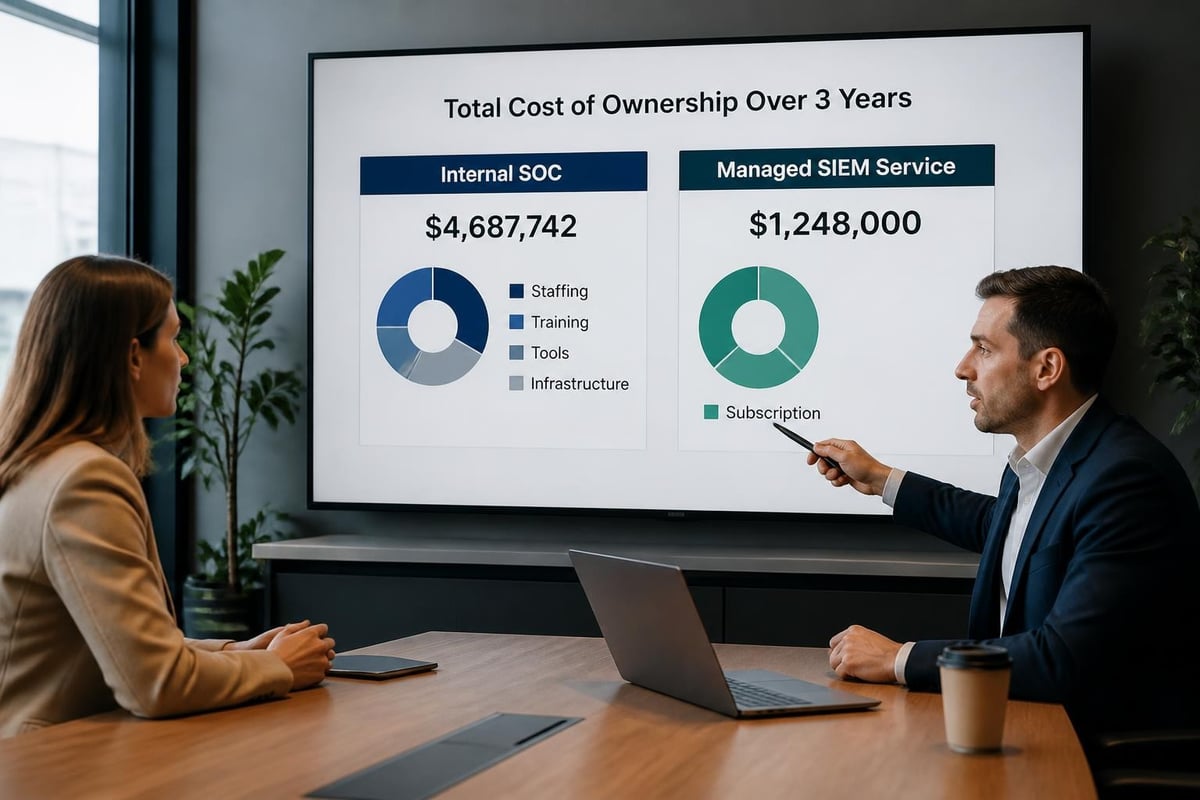
Managed SIEM services follow subscription pricing models that typically charge based on data volume (gigabytes per day), log sources, or user count. Understanding cost drivers helps organizations budget appropriately and maximize return on investment.
Most providers price by daily data ingestion volume, with tiers starting around 5-10 GB/day for small deployments and scaling to hundreds of gigabytes for enterprises. Additional charges often apply for premium features like advanced threat intelligence, extended data retention beyond standard periods (typically 90 days), or dedicated analyst resources.
Organizations should account for onboarding costs, which include initial use-case development, log source integration, and tuning periods. Quality providers invest 30-60 days in baselining normal behavior and reducing false positives before charging full production rates.
Total cost of ownership factors:
Comparing managed SIEM services to internal SOC operations reveals significant savings. A three-person SOC team costs $300,000-$500,000 annually in salaries alone, before accounting for benefits, training, tools, and infrastructure. Managed services deliver equivalent or superior coverage starting at $50,000-$150,000 annually depending on scale.
Not all managed SIEM services deliver equal value. Organizations should evaluate providers across multiple dimensions to ensure alignment with security needs, compliance requirements, and operational workflows.
Technical capabilities form the foundation. Does the provider support your existing technology stack? Can they ingest logs from cloud platforms, legacy applications, and specialized industrial control systems? Verify they maintain integrations for your priority log sources and can customize connectors when necessary.
Industry expertise matters tremendously. Providers familiar with your sector understand relevant threats, compliance requirements, and business processes. A managed SIEM service provider experienced in healthcare recognizes HIPAA workflow requirements and healthcare-specific attack patterns that generalist providers might miss.
Service level agreements (SLAs) define response expectations and provider accountability. Review guaranteed response times for different alert severities, uptime commitments for the SIEM platform, and escalation procedures for critical incidents. Strong SLAs include financial penalties when providers fail to meet commitments.
Before signing contracts, organizations should conduct thorough due diligence. Request proof of analyst certifications and ask about average analyst tenure-high turnover indicates potential quality issues. Inquire about use-case development processes and how frequently detection rules receive updates.
The TechTarget / SearchSecurity resource library offers vendor-neutral evaluation frameworks and buyer guides that help organizations compare offerings objectively. These resources provide question templates and assessment scorecards for managed security services.
Request references from organizations with similar environments and compliance requirements. During reference calls, ask about false positive rates, incident escalation quality, and how providers handle custom requests outside standard service scope.
Managed SIEM services function as the correlation hub within broader security architectures. Effective deployments integrate tightly with existing security controls and workflow tools to maximize detection coverage and response efficiency.
Modern security architectures combine multiple detection layers. Endpoint detection and response (EDR) platforms monitor individual workstations and servers, network detection and response (NDR) solutions analyze traffic flows, and cloud security posture management (CSPM) tools assess configuration risks. Managed SIEM services aggregate alerts from these specialized tools, correlating disparate signals into unified incident narratives.
This layered approach addresses the reality that no single tool detects every threat. An attacker might use stolen credentials to authenticate successfully past identity controls (generating authentication logs the SIEM sees) while deploying malware that EDR detects. The SIEM correlates these separate events into a complete attack picture.
Physical security monitoring also benefits from integration with digital security operations. Just as security gates and access control systems protect physical premises, managed SIEM services monitor digital perimeters. Organizations with sophisticated physical security often overlook cybersecurity until breaches occur. For businesses that already understand the value of layered physical protection-such as combining security gates with surveillance systems-managed SIEM services provide equivalent defense-in-depth for digital assets.
Speaking of comprehensive security, organizations serious about protection recognize that security extends beyond digital networks. Monkey proof gates from providers like Limax Security Specialists demonstrate how thoughtful design addresses specific threats, whether from wildlife or intruders. The same principle applies to managed SIEM services: effective security requires solutions tailored to actual risks, not generic approaches.

Managed SIEM services should integrate with existing IT service management (ITSM) platforms. When analysts confirm security incidents, automated ticketing in ServiceNow, Jira, or similar systems ensures proper tracking and documentation. Bidirectional integration allows SIEM platforms to query CMDB data for asset context and enables incident responders to access SIEM investigations directly from tickets.
Collaboration platforms like Microsoft Teams or Slack receive real-time alerts for critical incidents, notifying response teams immediately. These integrations reduce mean time to respond (MTTR) by eliminating manual notification steps and providing security context within tools teams already use daily.
The managed SIEM landscape continues evolving as providers incorporate emerging technologies and address sophisticated threat actors. Organizations evaluating services in 2026 should understand these advanced capabilities.
UEBA applies machine learning to establish baseline behaviors for users, devices, and applications, then detects anomalies that suggest compromise. Unlike signature-based detection, which identifies known attack patterns, UEBA discovers unknown threats by recognizing deviations from normal activity.
For example, UEBA might flag when an employee who typically accesses five files daily suddenly downloads 5,000 documents, or when a service account begins authenticating from unusual geographic locations. These behavioral anomalies often represent the earliest indicators of insider threats, compromised credentials, or advanced persistent threats (APTs).
Quality managed SIEM services include UEBA tuning as part of their offering. Analysts review behavioral alerts, provide feedback to machine learning models, and suppress expected anomalies (like quarterly reports that generate temporary spikes in database access).
Beyond reactive alert response, advanced managed SIEM services include proactive threat hunting. Dedicated hunters query telemetry for indicators of compromise (IOCs) associated with new campaigns, search for dormant threats that evaded initial detection, and validate security control effectiveness.
The ENISA NIS360 (2024) analysis describes how managed service providers increasingly offer hunt-forward operations that assume compromise and actively search for hidden threats. This shift from purely defensive postures to assumption-of-breach mentalities reflects the sophisticated threat landscape organizations face.
Threat hunting programs typically operate on monthly or quarterly cycles. Hunters develop hypotheses about potential threats-"attackers may have planted web shells in public-facing applications"-then systematically query SIEM data to prove or disprove these theories. Successful hunts uncover threats that automated detection missed, strengthening overall security postures.
Organizations transitioning to managed SIEM services follow structured implementation paths that minimize disruption while establishing comprehensive monitoring. Successful deployments typically span 60-90 days from contract signature to full production operation.
Implementation begins with asset discovery and log source identification. Providers work with IT teams to inventory all systems requiring monitoring, assess current logging configurations, and identify gaps. This phase includes technical workshops to understand network architecture, compliance requirements, and business-critical assets requiring enhanced monitoring.
Security teams should document existing use cases and detection rules if migrating from another SIEM. Providers can translate these into their platforms, preserving institutional knowledge while adding new capabilities. Organizations without existing detection content work with providers to develop initial use-case libraries based on industry baselines and threat intelligence.
Technical integration follows planning. Providers deploy log collectors, configure forwarding rules, and validate data ingestion. Initial onboarding focuses on high-value sources-domain controllers, firewalls, cloud infrastructure-before expanding to comprehensive coverage.
Typical integration sequence:
Concurrent with integration, SIEM platforms baseline normal activity. Machine learning models train on typical user behaviors, network traffic patterns, and application usage. This baseline period-usually 30 days-reduces false positives by establishing what "normal" looks like before enabling all detection rules.
The tuning phase addresses alert quality. Analysts review every automated detection, suppressing false positives while ensuring genuine threats trigger alerts. Organizations should expect daily tuning calls during this period as teams refine correlation rules and adjust thresholds.
Once false positive rates drop to acceptable levels (typically < 5% of total alerts), managed SIEM services transition to full production. Providers begin formal SLA enforcement, and 24/7 monitoring covers all configured use cases. Quarterly business reviews start, providing executives visibility into threat landscapes and security posture improvements.
Managed SIEM services require ongoing measurement to validate ROI and identify improvement opportunities. Organizations should track key performance indicators (KPIs) that reflect detection effectiveness, operational efficiency, and business risk reduction.
Mean time to detect (MTTD) measures how quickly the SIEM identifies security events after they occur. Industry benchmarks suggest strong managed SIEM services achieve MTTD under 15 minutes for critical threats. Mean time to respond (MTTR) tracks how long incident response takes from detection to containment. Together, these metrics indicate how effectively managed services compress the window attackers have to cause damage.
Alert accuracy percentages show how well detection rules distinguish true threats from false alarms. Services should maintain accuracy above 95%, with continuous improvement as use cases mature. Low accuracy wastes analyst time and erodes trust in security monitoring.
Coverage metrics track what percentage of the attack surface receives monitoring. Organizations should measure log source onboarding completion, use-case development progress against MITRE ATT&CK framework coverage, and gaps in telemetry collection.
| Metric | Target | Industry Average | Improvement Action |
|---|---|---|---|
| MTTD | < 15 min | 24 hours | Enhance automation, add detections |
| MTTR | < 1 hour | 4 hours | Improve playbooks, faster escalation |
| Alert Accuracy | > 95% | 60-70% | Continuous tuning, UEBA enhancement |
| Use-Case Coverage | > 80% | 45-50% | Quarterly use-case development |
Beyond operational metrics, organizations should quantify business value. Track prevented incidents-situations where managed SIEM services detected and stopped attacks before damage occurred. Calculate potential loss avoidance by estimating costs of successful breaches (regulatory fines, business disruption, reputation damage) that monitoring prevented.
Compliance audit performance provides another value indicator. Organizations with mature managed SIEM services pass security control audits with fewer findings and reduced remediation costs. Document time savings during audit evidence collection, as SIEM platforms automatically generate compliance reports that would otherwise require manual compilation.
Managed SIEM services provide organizations with enterprise-grade threat detection and response capabilities that would be difficult and expensive to build internally. By combining advanced technology platforms with skilled security analysts operating around the clock, these services deliver continuous monitoring, expert investigation, and rapid incident response that strengthen overall security postures. Whether you're protecting digital networks or physical premises, security requires layered defenses tailored to real threats. Limax Security Specialists understands comprehensive protection-from advanced security gates and burglar bars that defend physical assets to expert guidance on securing your complete business environment. Contact Limax today to discuss how integrated security solutions can protect everything you've built.


