

Data breaches increasingly originate from endpoints-the laptops, workstations, and mobile devices where employees create, access, and manipulate sensitive information daily. As organizations expand remote work arrangements and adopt hybrid environments, the traditional network perimeter has dissolved, placing unprecedented pressure on endpoint security. DLP endpoint protection has emerged as a critical defense layer, monitoring and controlling sensitive data directly at its point of use to prevent unauthorized transmission, storage, or modification. Understanding how to implement, manage, and optimize endpoint-level data loss prevention capabilities has become essential for organizations seeking to protect intellectual property, customer data, and regulatory compliance.
DLP endpoint protection operates as software agents installed directly on individual devices, creating a protective boundary around sensitive data wherever it resides or travels. Unlike network-based DLP solutions that monitor traffic at gateway chokepoints, endpoint agents follow data through its complete lifecycle on the device itself.
The National Institute of Standards and Technology defines data loss prevention as technology designed to detect and prevent unauthorized transmission of sensitive information. Endpoint implementations extend this concept by protecting data in three critical states: data at rest (stored files), data in use (active documents and applications), and data in motion (transfers and communications originating from the device).
Modern endpoint DLP architectures integrate several interconnected components that work together to identify, monitor, and control sensitive information:
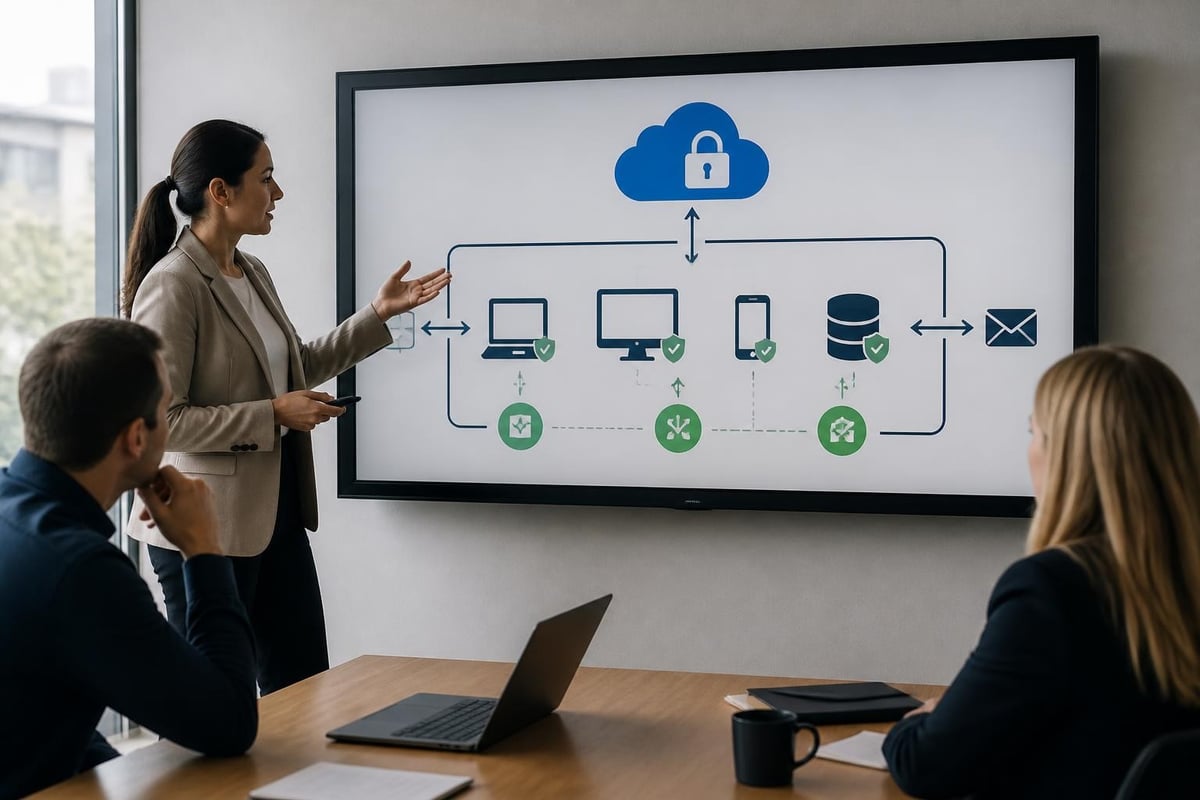
Each component must operate efficiently to avoid degrading device performance while maintaining comprehensive coverage of potential data leakage vectors.
Organizations face evolving threats that specifically target endpoints as the weakest link in data security chains. The ENISA Threat Landscape 2025 documents increasing sophistication in adversary tactics designed to exfiltrate data from compromised endpoints while evading traditional network monitoring.
Insider threats represent a particularly challenging category, encompassing both malicious employees intentionally stealing data and well-meaning staff who inadvertently expose information through careless handling. According to recent industry research, approximately 60% of data breaches involve some form of insider action, whether intentional or accidental.
Ransomware operators increasingly combine encryption attacks with data exfiltration, stealing sensitive files before encrypting systems to maximize extortion leverage. The CISA ransomware guide emphasizes that preventing data exfiltration requires controls at the endpoint level, where attackers typically stage stolen data before transmission.
Beyond insider scenarios, external attackers exploit endpoint vulnerabilities to establish persistence and systematically extract valuable data:
| Attack Method | Endpoint Risk | DLP Countermeasure |
|---|---|---|
| Phishing with credential theft | Legitimate user access to sensitive data | Context-aware access policies |
| Malware with keylogging | Capture of credentials and confidential information | Application control and monitoring |
| Cloud sync abuse | Unauthorized upload to personal accounts | Cloud connector blocking |
| Removable media exfiltration | Physical data theft via USB drives | Device control policies |
| Encrypted channel abuse | Data tunneled through HTTPS/DoH | SSL inspection and traffic analysis |
Recent IEEE research on detecting exfiltration over encrypted channels like DNS-over-HTTPS highlights how attackers leverage legitimate protocols to bypass network-level monitoring, reinforcing why endpoint-based detection remains essential.
Successful dlp endpoint protection implementation requires careful planning, phased deployment, and continuous refinement. Organizations frequently stumble by attempting to activate all policies simultaneously, creating overwhelming false positive rates that erode user trust and security team effectiveness.
Before enforcing any protection policies, organizations must identify what sensitive data exists on endpoints and establish consistent classification schemes. Modern DLP solutions incorporate machine learning-assisted classification that can recognize sensitive patterns without requiring exhaustive manual tagging.
The NIST IR 8505 publication discusses how modern data protection techniques, including automated classification and labeling, enable more effective DLP policy application in cloud-native and distributed environments.
Discovery scanning should cover:
Prioritize discovery efforts based on data sensitivity and regulatory requirements rather than attempting comprehensive scanning immediately.

Well-designed policies balance security requirements against operational practicality, preventing legitimate work from becoming unnecessarily difficult. TechTarget’s endpoint DLP best practices guide recommends starting with monitoring-only policies that log potential violations without blocking, allowing security teams to refine rules before enforcement.
Policy categories typically include:
Each policy should specify exact data types, permitted actions, approved destinations, and exception processes for legitimate business needs.
DLP endpoint protection introduces operational complexity that organizations must address proactively to maintain both security effectiveness and user productivity.
Endpoint agents consume system resources for content scanning, policy evaluation, and logging activities. Poorly optimized deployments can noticeably slow device performance, particularly on older hardware or resource-constrained mobile devices.
Mitigation strategies include:
Organizations should establish performance baselines before DLP deployment and monitor key metrics like CPU utilization, disk I/O, and application response times.
Security controls that obstruct normal workflows inevitably generate user frustration and resistance. Academic research on data exfiltration defense emphasizes that human factors significantly influence the effectiveness of technical controls, with poorly communicated policies leading to workarounds that undermine security.
Effective user engagement requires:
Just as physical security requires user cooperation-much like how Monkey-Proof Security Gates protect properties more effectively when residents understand how to properly operate and maintain them-endpoint security depends on informed users who recognize their role in protecting organizational data.

| Challenge | Impact | Solution Approach |
|---|---|---|
| False positives blocking legitimate work | Reduced productivity, policy circumvention | Whitelist common workflows, context-aware rules |
| Complex exception request processes | Delayed business operations | Streamlined approval workflows, delegation |
| Inconsistent policy application | User confusion, compliance gaps | Unified policy framework, clear documentation |
| Lack of visibility into why blocks occur | User frustration, help desk burden | Informative block messages, self-service guidance |
Modern dlp endpoint protection solutions extend beyond simple file blocking to provide sophisticated protection mechanisms aligned with contemporary threat scenarios and work patterns.
Next-generation endpoint DLP systems evaluate multiple contextual factors when making policy decisions, moving beyond static rules to dynamic risk assessment. Context-aware policies consider:
This multidimensional approach reduces false positives while strengthening protection against genuine threats.
Endpoint DLP operates most effectively when integrated with complementary security technologies that provide additional context and coordinated response capabilities. The CISA CDM technical capabilities document outlines how data protection capabilities should integrate with asset management, vulnerability scanning, and incident response systems.
Key integration points include:
These integrations transform endpoint DLP from an isolated control into a component of defense-in-depth strategy.

The shift toward distributed workforces fundamentally changed endpoint security requirements, with corporate data regularly accessed from home networks, coffee shops, and remote offices lacking traditional perimeter defenses.
Remote endpoints require DLP protection that functions reliably regardless of network connectivity or location. Unlike network-based DLP that only monitors traffic passing through corporate gateways, endpoint agents must enforce policies consistently whether devices connect through VPN, direct internet access, or offline operation.
Critical capabilities for remote scenarios:
Organizations should test endpoint DLP behavior across representative remote access scenarios before widespread deployment.
Bring-your-own-device policies introduce additional complexity, as organizations must balance data protection requirements against employee privacy expectations on personally owned equipment. Full endpoint DLP deployment on personal devices often proves impractical or unacceptable to users.
Alternative approaches include:
Each approach involves trade-offs between security coverage, user experience, and implementation complexity.
Organizations need objective metrics to evaluate whether their dlp endpoint protection investments deliver intended security improvements without creating excessive operational burden.
Security effectiveness metrics include:
Operational efficiency metrics track:
The SANS whitepaper on endpoint detection effectiveness discusses how organizations should evaluate both technical efficacy and operational sustainability of endpoint controls.
DLP programs require ongoing refinement as business processes evolve, new data types emerge, and threat landscapes shift. Establish regular review cycles that:
Quarterly policy reviews and annual program assessments provide appropriate cadence for most organizations.
Choosing the right endpoint DLP solution requires evaluating technical capabilities, vendor viability, and organizational fit across multiple dimensions.
| Evaluation Criteria | Key Questions | Weight Factor |
|---|---|---|
| Platform coverage | Does it support all required OS versions and device types? | High |
| Content inspection depth | Can it detect sensitive data in all relevant formats and applications? | High |
| Performance footprint | What is the measured impact on endpoint performance? | High |
| Policy flexibility | How granular and contextual can rules become? | Medium |
| Integration capabilities | Does it connect with existing security and IT systems? | Medium |
| Management complexity | How much administrative effort does ongoing operation require? | Medium |
| Vendor support quality | What support levels and response times are guaranteed? | Medium |
| Total cost of ownership | What are licensing, implementation, and operational costs? | High |
Request proof-of-concept deployments that test solutions against actual organizational data, use cases, and infrastructure before committing to enterprise-wide deployment.
DLP endpoint protection forms an essential component of modern data security strategy, providing critical visibility and control over sensitive information at its point of use. By implementing thoughtful policies, maintaining operational discipline, and continuously adapting to evolving threats and business needs, organizations can significantly reduce data breach risk while supporting legitimate productivity. Just as Limax Security Specialists helps South African property owners implement layered physical security that balances protection with usability, comprehensive endpoint DLP programs require the same thoughtful integration of technology, process, and user experience to deliver lasting security value without impeding business operations.


