
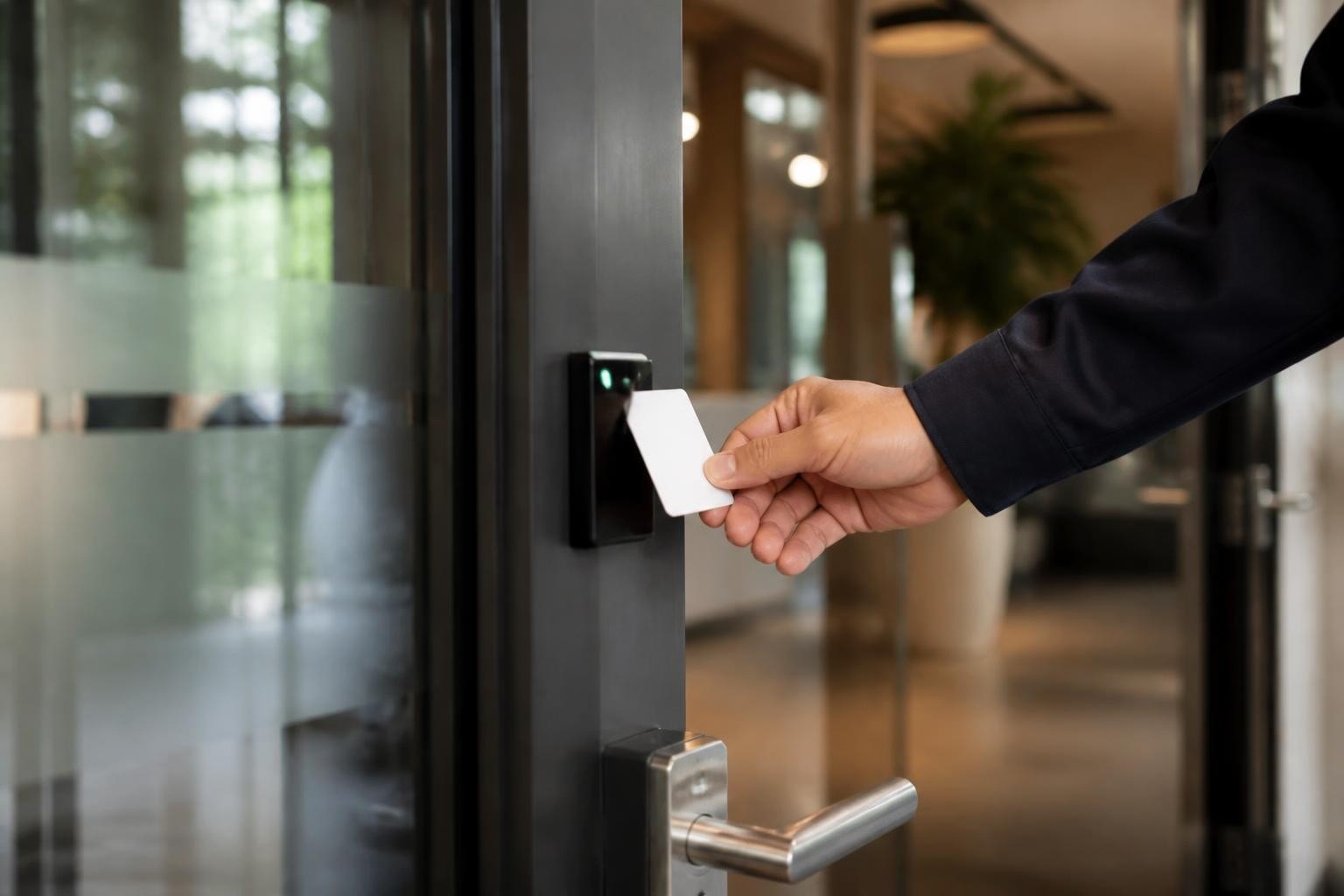
Modern security demands sophisticated solutions that balance convenience with protection. Card access control systems have evolved from simple magnetic stripe readers into advanced authentication platforms that manage entry permissions, audit trails, and threat detection across residential estates, commercial offices, and industrial facilities. These systems replace traditional lock-and-key mechanisms with programmable credentials that grant or deny access based on predefined rules, creating layers of security that adapt to changing needs without physical rekeying.
Card access control systems authenticate users through credentials embedded with unique identifiers. When presented to a reader, the card transmits its data-either through contact, proximity, or contactless radio-frequency transmission-to a control panel that verifies permissions against a database.
The architecture consists of four primary components working in concert:
Different card technologies offer varying levels of security, read range, and cost. Understanding these distinctions helps organizations select appropriate solutions for their risk profile.
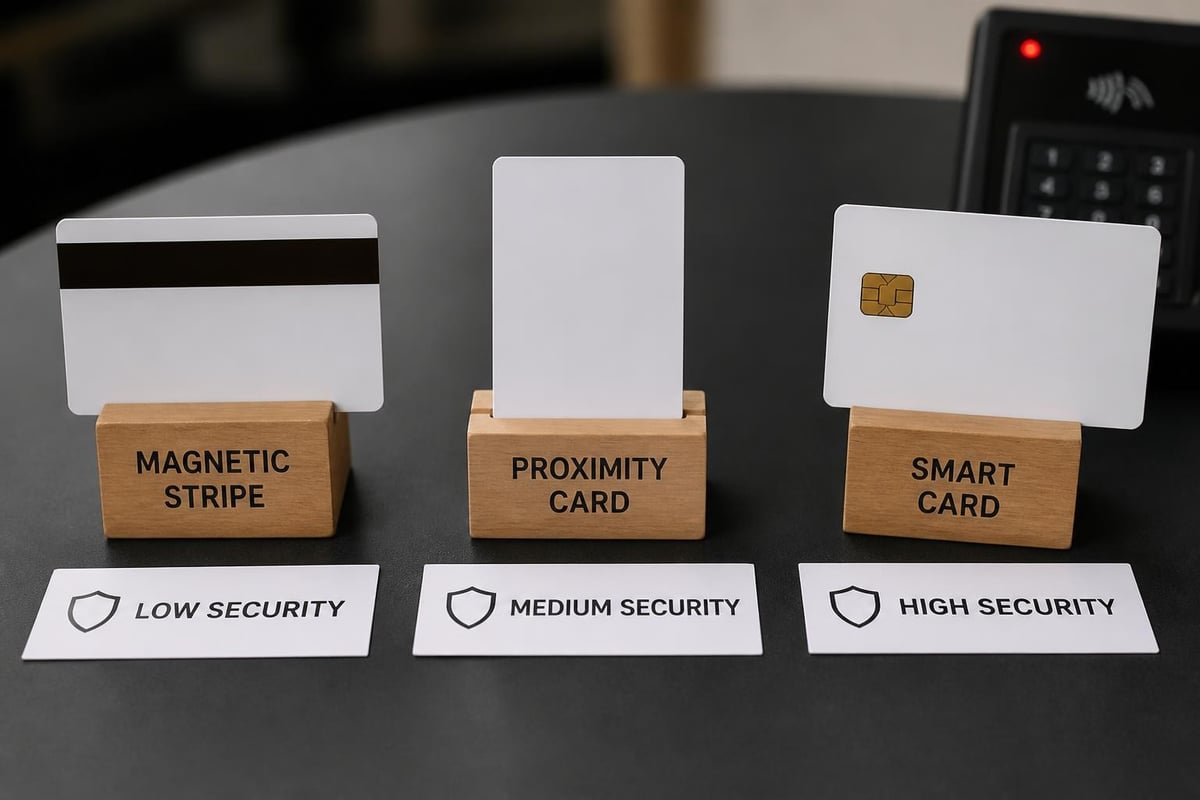
Magnetic stripe cards represent the oldest technology, storing data on a magnetic band similar to credit cards. These cards require physical contact with the reader and offer minimal encryption, making them vulnerable to cloning and skimming attacks. Despite security limitations, they remain cost-effective for low-risk applications.
Proximity cards (125 kHz) transmit data wirelessly when held near a reader, typically within 3-4 inches. The convenience of hands-free operation made prox cards ubiquitous in the 1990s and early 2000s, but their unencrypted transmission and simple identifier structure expose them to sophisticated attacks. According to research published in IEEE Access, RFID-based access systems face numerous privacy and security challenges that require layered mitigation strategies.
Smart cards (13.56 MHz) incorporate embedded microprocessors that perform cryptographic operations, mutual authentication, and secure data storage. These credentials-including MIFARE DESFire, iClass, and government PIV cards-encrypt communications between card and reader, substantially increasing clone resistance.
| Technology Type | Read Range | Encryption | Clone Resistance | Typical Cost |
|---|---|---|---|---|
| Magnetic Stripe | Contact | None | Very Low | $0.50-$1.50 |
| Proximity (125 kHz) | 2-4 inches | Minimal | Low | $1-$3 |
| Smart Card (13.56 MHz) | 1-3 inches | Strong | High | $3-$8 |
| Mobile/BLE | 6-30 feet | Very Strong | Very High | Software only |
Organizations implementing card access control systems gain operational advantages that extend beyond simple door locking. The digital nature of credential management transforms security from reactive to proactive.
Centralized permission management eliminates physical key distribution and collection. Security administrators modify access rights instantly through software, granting temporary permissions for contractors, restricting access to sensitive areas, or deactivating lost credentials without changing locks. This flexibility proves especially valuable for properties with high turnover or complex access hierarchies.
Comprehensive audit trails record every entry attempt with timestamp, credential identifier, and door location. This accountability deters unauthorized activity while providing forensic evidence during investigations. The ASIS International 2023 Access Control Research Report found that 78% of surveyed organizations consider detailed logging among the top three benefits of modern access systems.
Time-based access scheduling reduces administrative overhead for facilities with varying operational hours. Employees receive automatic access during their scheduled shifts while being restricted after hours, eliminating manual lock/unlock routines.
Integration capabilities connect card access control systems with video surveillance, intrusion detection, and building automation platforms. When a credential triggers an access event, cameras automatically record the entry, elevators route to authorized floors, and lighting systems activate-creating unified security ecosystems that respond intelligently to human movement.
For South African properties facing persistent security challenges, physical barriers remain essential. Many organizations pair electronic access systems with robust perimeter protection such as security gates designed to resist forced entry, creating defense-in-depth strategies where authentication credentials control who approaches sensitive entry points protected by structural barriers.

Successful deployment begins with thorough site analysis that maps access points, user populations, and security requirements. This planning phase determines system architecture, credential selection, and integration needs before equipment purchases commit organizations to specific platforms.
Not every door requires electronic access control. Risk-based assessment prioritizes high-value areas, external entry points, and locations with compliance mandates. Consider these factors when evaluating each access point:
Exterior doors facing public areas demand more robust authentication than internal office dividers. Server rooms, pharmacies, and research facilities warrant multi-factor authentication combining cards with PIN codes or biometric verification.
The number and types of users shapes system sizing and credential strategy. Residential estates with 500 homeowners require different management tools than corporate offices with 5,000 employees plus rotating contractors and visitors.
Temporary access needs influence credential choice. Facilities hosting frequent short-term guests benefit from mobile credentials delivered via smartphone apps, eliminating physical card issuance and collection. Conversely, industrial sites may prefer durable proximity cards that withstand harsh environments and don't depend on battery-powered devices.
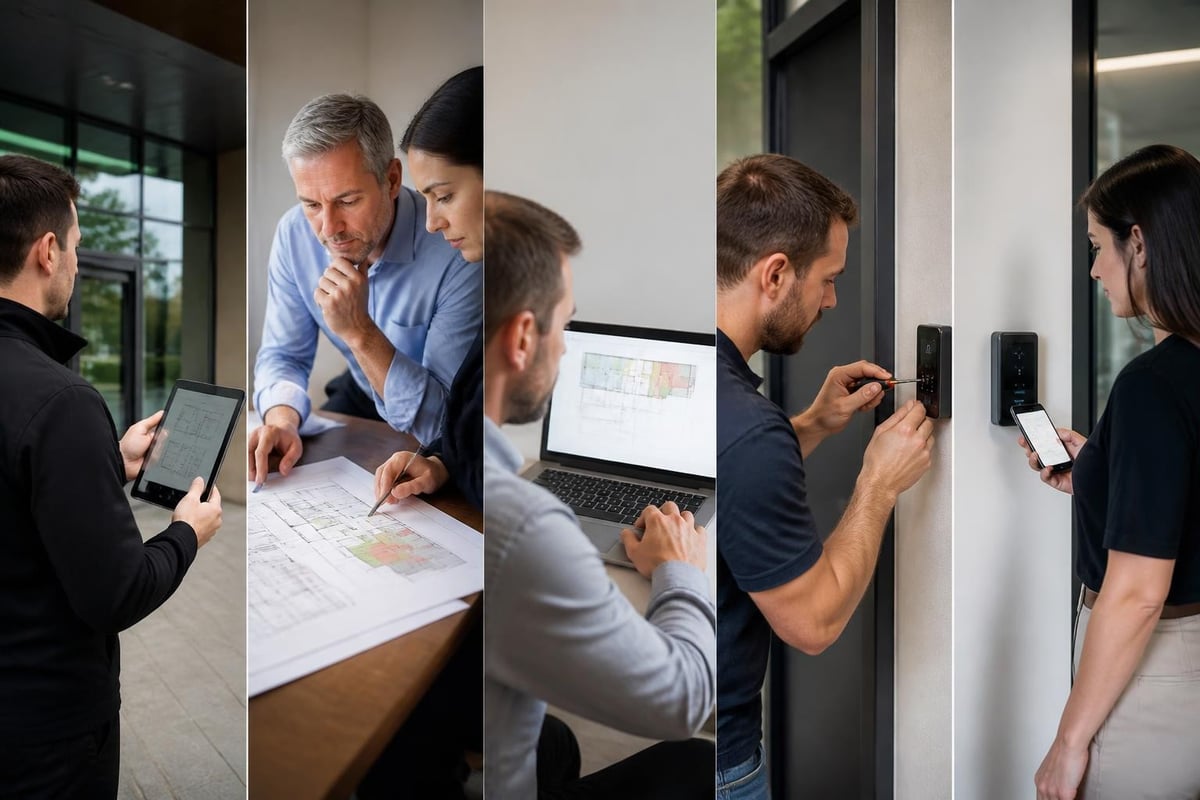
System security depends equally on technology selection and operational policies governing credential lifecycle. Even the most sophisticated smart cards become vulnerabilities when organizations fail to implement proper issuance, monitoring, and revocation procedures.
Enrollment protocols establish user identity before issuing credentials. Robust systems require government-issued identification, employment verification, and background screening appropriate to access levels granted. NIST guidelines for PIV credential use in physical access control systems emphasize the importance of identity proofing before credential binding.
Defining access permissions by role rather than individual streamlines administration for large user populations. Instead of configuring 1,000 unique permission sets, administrators create role templates like "Marketing Department," "Facilities Manager," or "Weekend Security" with predefined access rights.
New employees inherit permissions by role assignment. Promotions, transfers, or terminations trigger automated permission updates without manual door-by-door reconfiguration. This approach reduces human error while enforcing principle of least privilege-users receive only the access necessary for their functions.
Multi-level authorization adds security layers for high-risk areas. Requiring two valid credentials simultaneously prevents single compromised cards from breaching sensitive zones. Similarly, time-delay mechanisms prevent tailgating by enforcing minimum intervals between entries.
Organizations collecting access data assume legal and ethical responsibilities for that information. Card swipe logs constitute personal data under numerous privacy regulations, requiring protection, retention policies, and access restrictions.
The European Union’s ENISA guidance on security measures addresses physical access controls within broader cybersecurity frameworks, highlighting how access logs can reveal sensitive patterns about individual behavior and location.
Data minimization principles limit collection to operationally necessary information. Systems should log door access without unnecessarily capturing additional metadata. Retention periods balance investigative needs against privacy exposure-most organizations retain access logs 30-90 days unless specific incidents warrant extended preservation.
Industry-specific mandates drive access control implementations:
South African organizations must align access control policies with the Protection of Personal Information Act, ensuring that access logs containing employee data receive appropriate safeguards and that individuals can request access to information collected about their movements.
Modern card access control systems extend beyond simple door unlocking to become platforms for physical security orchestration. These advanced capabilities transform standalone access points into intelligent security ecosystems.
Anti-passback protection prevents credential sharing by tracking user location. Once a card grants entry to a facility, it cannot re-enter until it exits, detecting attempts to pass credentials back through doors to unauthorized individuals. This logical constraint complements physical barriers at entry points.
Linking access events to video surveillance provides visual confirmation of credential use. When unusual patterns emerge-after-hours access, repeated failed attempts, or high-value area entries-operators receive alerts with corresponding video clips for immediate investigation.
Modern analytics apply computer vision to detect tailgating (unauthorized individuals following valid users through doors), loitering near entry points, or behavioral anomalies that suggest social engineering attempts. These AI-enhanced systems reduce false alarms while flagging genuine threats that rule-based monitoring misses.
Mobile credentials delivered through smartphone apps represent the latest evolution in access technology. Bluetooth Low Energy (BLE) and NFC-enabled devices authenticate users without dedicated cards, leveraging strong encryption and remote management. The CISA catalog of physical access control recommendations includes guidance on securing mobile credential implementations against emerging attack vectors.
Card access control systems require ongoing maintenance to sustain security effectiveness and operational reliability. Neglected systems accumulate orphaned accounts, outdated firmware, and degraded hardware that creates vulnerabilities.
Regular access reviews audit current permissions against employee status. Quarterly reviews identify terminated employees whose access wasn't deactivated, contractors with expired agreements still holding valid credentials, or privilege creep where users accumulated unnecessary permissions over time.
Hardware inspections catch failing readers, worn card contacts, and electromagnetic lock degradation before complete failure. Exterior readers face particular stress from weather exposure, vandalism attempts, and UV degradation requiring protective housings and periodic replacement.
Access control panels run embedded operating systems and communication protocols vulnerable to discovered exploits. Manufacturers release firmware updates addressing security vulnerabilities, compatibility issues, and feature enhancements. Delaying updates exposes systems to known attacks while creating integration problems with other security platforms.
Testing updates in isolated environments before production deployment prevents disruptions. A failed firmware update that locks all doors during business hours can paralyze operations, making staged rollouts and backup procedures essential.
The Springer taxonomy of RFID security issues catalogs vulnerabilities that firmware updates and system hardening can mitigate, from eavesdropping attacks to relay exploits that extend card read range beyond physical proximity.

| Maintenance Task | Frequency | Criticality | Typical Duration |
|---|---|---|---|
| Access permission audit | Quarterly | High | 4-8 hours |
| Reader/lock hardware inspection | Monthly | Medium | 2-3 hours |
| Firmware and software updates | As released | High | 1-4 hours |
| Battery backup testing | Semi-annually | High | 1-2 hours |
| Full system backup | Weekly | Critical | 30 minutes |
| User credential re-enrollment | Annually | Medium | Varies by size |
Despite careful implementation, card access control systems encounter operational problems requiring systematic diagnosis. Understanding typical failure modes accelerates resolution and minimizes security gaps.
Credential read failures rank among the most frequent issues. Cards may fail due to physical damage, demagnetization, battery depletion (for active credentials), or simply incorrect presentation to readers. Distinguishing between card problems and reader malfunctions requires testing multiple credentials at the affected reader and the problem card at known-good readers.
Access control systems depend on reliable network connectivity between readers, panels, and management servers. Network outages, IP conflicts, or firewall misconfigurations sever this communication, preventing real-time access decisions or logging.
Offline operation capabilities allow panels to continue authenticating credentials using cached permissions during network disruptions, but these local databases require regular synchronization. Extended offline periods create audit gaps and prevent immediate credential revocation.
Power failures affect electronic locks differently based on their fail-safe (unlock on power loss) or fail-secure (remain locked) configuration. Battery backup systems should maintain operation for 4-8 hours during outages, but aging batteries lose capacity. Regular testing under load conditions verifies backup sufficiency.
Card access control systems continue evolving through emerging technologies that enhance security, convenience, and integration depth. Organizations planning implementations should consider these trajectories when selecting platforms.
Biometric fusion combines card credentials with fingerprint, facial recognition, or iris scanning for multi-factor authentication. While cards confirm "something you have," biometrics verify "something you are," substantially increasing clone resistance and preventing credential sharing.
Cloud-based access platforms shift management from on-premise servers to SaaS models offering scalability, automatic updates, and mobile administration. These systems reduce IT infrastructure requirements while enabling multi-site management from unified dashboards. However, cloud dependency introduces internet connectivity as a single point of failure requiring careful architectural consideration.
Artificial intelligence applied to access patterns detects anomalies suggesting compromised credentials, insider threats, or social engineering attacks. Machine learning algorithms establish behavioral baselines for each user, flagging unusual access times, frequency changes, or geographic impossibilities that rule-based systems miss.
Zero-trust security models treat every access request as potentially hostile, requiring continuous verification rather than perimeter-based trust. Card credentials become one factor in continuous authentication systems that consider location, time, accessed resources, and behavioral patterns before granting permissions.
The access control market offers platforms ranging from simple standalone readers to enterprise-grade systems managing thousands of doors across multiple facilities. Matching system capabilities to actual requirements prevents over-investment in unused features or under-investment creating security gaps.
Standalone systems operate without network connectivity or central management. Each reader maintains its own credential database, requiring physical programming at the device. These systems suit small businesses with 1-3 doors, limited budgets, and minimal access changes.
Networked systems connect readers to central control panels managing permissions, logging, and door control across entire facilities. This architecture suits most commercial and residential applications, balancing cost against administrative efficiency.
Enterprise platforms integrate physical access with HR databases, visitor management, video surveillance, intrusion detection, and building automation. These comprehensive systems require substantial investment but deliver operational efficiency and unified security posture for large organizations.
Choosing an access control provider involves evaluating technical capabilities, support quality, and long-term viability. Consider these factors during vendor assessment:
South African businesses should prioritize vendors with established local presence, understanding of regional security challenges, and experience with POPIA compliance requirements.
Card access control systems deliver sophisticated security management that traditional lock-and-key approaches cannot match, combining centralized permission control with detailed audit trails and flexible integration capabilities. Whether protecting a residential estate, commercial office, or industrial facility, the right access control implementation enhances both security effectiveness and operational efficiency. Limax Security Specialists combines electronic access control expertise with comprehensive physical security solutions-from burglar bars to security gates-creating layered protection strategies tailored to South African properties. Contact Limax today to assess your facility's access control needs and design a system that balances security requirements with user convenience.


